


key con remodeling  dura-foam solar center  nil erdal realtor
Eichler Network CA Modern
ca modernmagazine cover
To Get
CA-Modern
Magazine
Click Here
los angeles conservancy
pixel
HOME | ABOUT | CONTACT | ADVERTISE
abril roofing


transparent pixel
eichler modern

About Belluschi Author Meredith Clausen

Contributing writer Meredith Clausen, Ph.D. is perhaps the leading authority on the subject of architect Pietro Belluschi, having written two books on the architect and his works and conducted countless hours of personal interviews up to his death, in 1994, at age 95.

clausen and belluschi

Clausen and Belluschi, 1988.

"It was an exceptional experience," she recalls, "as architects such as he are rare. He was a superb designer, with a keen, well-honed, educated eye. And an eloquent writer and speaker, as well as gentle in demeanor and generous of spirit."

Belluschi also was a shrewd businessman, and enormously successful, financially as well as professionally. Among his long list of design successes are two of San Francisco's most-famous structures -- the Bank of America building and St. Mary's Cathedral.

What are Clausen's impressions of Belluschi's 'Life' house? "I'll have to admit," she told us recently, "my impressions at first were colored by discussions I had had with a journalist who was tracking Belluschi's work for years, and he didn't think much of it.

"But after poring through Belluschi's correspondence from the late 1950s, I've discovered that he had a lot more to do with that house than many thought, the structure was unquestionably his design, and it indeed was much better than they gave him credit for."

book cover

Clausen presently is a professor of architectural history at University of Washington, where she has taught since 1979. Her two books on Belluschi are "Spiritual Space - the Architecture of Pietro Belluschi" (UofW Press, 1992) and "Pietro Belluschi - Modern American Architect" (MIT Press, 1994). A third, on Belluschi's Pan Am Building, is due out next year.


pixel

THE 'LIFE' HOUSE
Eichler meets revered architect Pietro Belluschi --
and builds a multi-level showpiece for Life magazine

From the pages of the Eichler Network newsletter
By Meredith L. Clausen

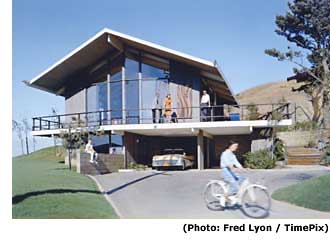
Two blocks away from the celebrated X-100 steel Eichler, in the San Mateo Highlands, stands another special custom-built Eichler house -- one that has been a well-kept secret for the past 40-plus years. Unlike any of the Highlands' Eichlers that preceded it, this one was built on four levels, against a hillside, and was a commissioned prototype designed by a gifted architect outside of Eichler Homes' usual stable.
Life house

Commonly referred to as the 'Life' house, this Eichler showpiece was launched by a phone call -- in fact, from the offices of 'Life Magazine'-- in September 1957. Pietro Belluschi, Dean of Architecture and Urban Planning at Massachusetts Institute of Technology, one of the top architecture schools in the country, was at the other end of that call. 'Life' wanted to know if Belluschi would be interested in designing a model house suitable for mass production as part of a series of articles 'Life' had underway on American housing.

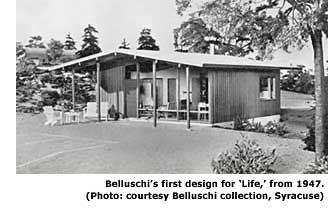
One of the most-renowned and successful architects on the West Coast, Belluschi had designed a model house for 'Life' a decade earlier, when he was still a practicing architect in Portland, Oregon. What 'Life' was looking for back then, in 1947 -- when the country was still recovering from a backlog in the building industry slowed first by the depression, then by the war -- was a prototype for a low-cost, expandable house. 'Life' wanted a house that could minimally be built for no more than $4,000, the maximum the publication figured the average 28-year-old returning veteran with a wife and small child could afford.

Belluschi was known not only for his supremely elegant, simple, modern, beautifully designed churches and houses typically of wood, but also for his ability to remain within limited budgets. The original house he designed for 'Life,' featured in the April 28, 1947 issue, consisted of a welcoming but unpretentious low-pitched roof structure, with deeply overhanging eaves sheltering a broad terrace; and an open plan, with living, dining, and kitchen area basically one, and a master bedroom and child's room off to a side.
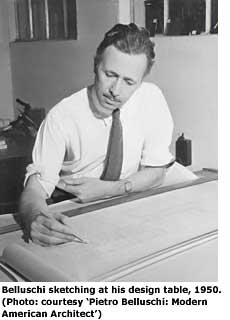
belluschi Belluschi's prototype was a startling success, generating a flood of letters from around the country requesting plans. A decade later, when 'Life' again tapped Belluschi for the design of a livable but affordable prototypical house, he had moved beyond residential work, and as dean at MIT was engaged in the design and planning of larger-scale structures, among them a new modern library for Bennington College; a $75-million commercial complex in Boston; Lincoln Center (for which he designed the Juilliard School of Music); as well as Grand Central City, or what was ultimately to become the Pan Am Building, in New York City.

For the 1958 'Life' house, which again had a strictly limited, albeit substantially larger, $25,000 budget, Belluschi returned to the concept of the minimal house -- basically rectangular in plan (though now with lofty ceilings and an angled prow on either end), low-pitched sheltering roof, deep eaves over broad terraces, and an open plan, with living, dining, and kitchen clustered together at one end facing the street, bedrooms behind looking out over the view. 'Life' had requested a split-level house on a sloped site generic enough in design to be built in all parts of the country with minor alterations to meet conditions of extreme heat or snow. To meet these requirements as well as remain within what he recognized as a severely limited budget for the kind of house 'Life' wanted, Belluschi doubled the square footage of the house and split it into four levels, staggering them so each made contact with the sloped ground.
One entered the house from the upward slope of the hill, several steps up from the carport, into an entry hall that led into the living area, with a door to the kitchen for deliveries off to the side. The master bedroom, with its own deck, was on the next tier up, visible from and opening onto the living space below, with bath and dressing rooms off to the side. Downstairs were the children's bedrooms and bath, and below them, again with the spaces staggered, were a family or 'all-purpose' room and the carport. The cedar-shingled roof and weathered redwood siding on the exterior were complemented by the cork floors and exposed wooden beams on the interior. Simple, practical, and efficient both in terms of space and materials, yet remarkably light and spacious, the 'Life' house exemplified Belluschi's handling of materials and planning skills at their best.

B/W Life house Everything screeched to a halt, however, when a New York estimator, brought in to verify costs, quoted a figure of $50,000, twice the $25,000 budget Belluschi was allowed. Knowing that building traditions were simpler and less expensive on the West Coast, Belluschi, who had collaborated with merchant builders before, turned to Joe Eichler, who figured that with a few changes in the design and the use of more standardized dimensions, he could build the house for $25,000. To prove it, Eichler brought in his long-standing architects, A. Quincy Jones and Frederick Emmons, who were familiar with Bay Area terrain and building codes, as associate architects. Eichler selected a lot on the edge of his thriving development in the San Mateo Highlands. The site, along the inclined eastern side of winding Yorktown Road, overlooked San Francisco bay and matched 'Life' Magazine's stipulation of a sloped site.

Life House

Orienting the house east-west so that it faced the street -- with carport below, main living spaces above, entry from the sloped side, and bedrooms behind looking out over the view -- Belluschi opened it up fully, so that natural light and views stretched unimpeded from one end of the house to the other. His aims were clear: to design a split-level house that fulfilled its main purpose of adapting to a sloped site; to demonstrate that with an economy of means a generous, livable space could be provided at a reasonable cost; to integrate the natural features of the site (existing trees, rocks, slope and view) into the design; and finally, to show throughout a concern for the fitness of materials to their varied and particular purposes.

"A modern house must of course provide all the material comforts that American people demand," Belluschi wrote in a statement of intent, "but these need not conflict with the emotional fulfillment which every man [sic] expects in a home. This is provided mainly by well-proportioned space, by fine relationships to earth and trees, by opening a view to the countryside, and by a sensous treatment of textures. These emotional qualities are the hardest to appraise and the hardest to achieve, but their appeal is instinctive in all people, even if not readily analyzed by them. An architect will elaborate his theme through an understanding of the moods and other peculiar traits of his client. There is no formula for designing a good home other than sympathy for people and love of nature."

Life House Much of this, and Belluschi's artistic philosophy in general, was inspired by Frank Lloyd Wright, whose appreciation of natural materials, integration of building and the natural site, and geometrically inspired forms were of course well known, especially on the West Coast. The hexagonal plan of the Belluschi-Eichler house, unusual in Belluschi's residential work, may in fact have been inspired in part by the plan of the Hanna house, built in 1938 on the Stanford campus, not far from the San Mateo site. But more likely, it was derived from Wright's recently published Unitarian Church, in Madison, Wisconsin, with its deeply overhanging prow-like roof and fully glazed front. Belluschi's means were typically simpler than Wright's. While he too drew heavily on traditional Japanese architecture, especially in his efficient use of space, use of natural materials, and integration of interior and exterior, Belluschi shied away from Wright's complex rapid rhythms, his repeated modules and reiterated linearity, in the interest of greater overall grace and simplicity.

The 'Life' house, designed by Belluschi and built with few changes by Eichler with Jones and Emmons, published in the October 6, 1958 issue, was even more successful, gauged by the number of requests for plans, than Belluschi's 1947 'Life' house. Inquiries from all over the world started pouring in within days after it was published, from doctors and lawyers as well as carpenters and builders. They continued throughout the next decade, the image kept alive in people's minds by a photograph of the house in a paint advertisement for Cabot's Ranch House Hues that appeared in popular magazines, such as 'House and Garden,' 'American Home Magazine,' 'Better Homes & Gardens' -- vivid testimony of the design's adaptability as well as broad appeal. Though the plans of the Belluschi-Eichler house were not stock and not available for sale, the house was replicated at least once, on Stanford campus, and evidently served as inspiration for countless builders and homeowners throughout the country, and perhaps the world, who had access to the plans and elevations as published in 'Life'.

life Eichler, too, recognized their marketability, and though he himself did not customarily build split-level designs -- preferring to stick to his usual single-story houses geared to a flat site -- he did ask Belluschi if he might be interested in designing a single-level house "more typical of our operation" which he could mass produce. But by this time, in late 1958, after the Belluschi-Eichler house was published in 'Life,' Belluschi was on to bigger things. The massive, highly controversial $100-million Grand Central City tower, the largest commercial office building in the world at the time -- to be built over Grand Central Station, in the heart of New York City -- which he had been asked to design in collaboration with Walter Gropius, pioneering founder of the Bauhaus and former head of Architecture at Harvard, was just beginning to take shape.

Soon to be rechristened the Pan Am Building, this tower was a much ballyhooed, but ill-fated project that was to bring Belluschi much remorse, anguish that was mitigated by the steady stream of appreciative letters from admirers all over the world seeking plans for his understated, but beautifully designed and reasonably priced house in San Mateo's Highlands. For his design in collaboration with Eichler Homes indeed was one that touched the hearts of many at the time.


Top of Page


Second Coming of the 'Life' House

Belluschi's Lone Clone: Reborn As a Majestic Stanford Hideaway

From the pages of the Eichler Network newsletter
By Marty Arbunich

His design of the 'Life' house well in hand, architect Pietro Belluschi beamed in early 1958, "I must say without vanity that I am quite pleased." By the time the rest of the world had a chance to chime in with praise following 'Life' Magazine's exposé later that year, Belluschi had retired his drawings of the San Mateo house, politely turning away a long and steady stream of inquiries requesting plans to turn the 'Life' house design into dream homes for themselves.

"The house which you inquired about was designed for a specific client, and the plans are not for sale," he and his secretary would routinely reply to inquirers over the next decade. When Belluschi finally broke down and, with the assistance of architect A. Quincy Jones, succumbed to what he termed a "special plea" from a lucky but soon-to-be-ungrateful Iowa man in 1963, the Midwesterner would unwisely send back the set of 'Life' house plans with Jones's unpaid $500 invoice, complaining, "These plans are much too expensive for me. I'm afraid the whole house is too expensive for me."

With forces like this at work, and in spite of the flood of interest from among Life's 32 million readers, one would not expect the 'Life' house to have spawned others in its image and likeness. But Eichler owner and Stanford law professor John McDonough, who, since 1951, had lived with his family in Palo Alto's Charleston Meadows development, took a different tack when the 'Life' spread caught his eye in October 1958. He simply knocked on Eichler Homes' door. "When the San Mateo house was built and put up for public view, we went up and saw it," recalled McDonough, now 82 and living in Cupertino. "And we fell in love with that house. So, we went to Joe Eichler--"

stanford house and the kallmans Already quite familiar, and impressed, with Eichler and his houses, it was easy for the McDonoughs to slip comfortably into a second Eichler home, even one as unusual as the 'Life' house. "We started with a favorable impression of Eichler," said McDonough. "When we were shopping for our first house, back in 1951, the Eichlers were startlingly different from any of the others we saw. And Eichler's company was the only builder in the area tied into the G.I. loan. We weren't all that struck by the house at first, but as we began to live there, we came to favor it very much."

And by 1958, the McDonoughs were looking for additional living space, beyond their 1,400-square-foot Eichler starter. At the same time, Stanford University decided to open up a large tract of university land, making it available for lease by way of a lottery system to select faculty members for building personal housing. McDonough found himself on the winning side of the lottery, and even man-aged to secure a lot on a slope. "Back then, you could lease the property for 80 years, and build your own house with no particular guidelines or restrictions as to style," McDonough remembered.

With his hillside lot secured, McDonough found the 'Life' house's multi-level orientation even more appealing. When he approached Eichler in late 1958, the builder didn't resist McDonough's proposal. "Eichler had done it once, he could do it again, and now he could even have a show place on the campus." McDonough pointed out.

Even though Eichler had made it clear in earlier correspondence with Belluschi that single-story designs were more in line with his production plan and land acquisitions, he nonetheless was proud enough of the original 'Life' house, and had worked out enough of the snags the first time around, to take on the custom build for McDonough. "As far as I could see," said McDonough, "he embraced the idea with some enthusiasm. In fact, he always seemed approachable, cooperative, and anxious to please."

McDonough and his family were indeed pleased when Eichler's 'Life' house re-creation, built for close to the same $25,000 price, was completed near the end of 1959. Architects Jones and Emmons, who had assisted Belluschi with modifications to the original house, made two significant changes for Eichler this time. The 'Life' house's unusual network of roof support beams that fanned out along the ceiling had been replaced by Eichler's trademark front-to-rear parallel beam system; and the carport, here replaced by a garage, had been position shifted to a different location.

"Eichler did a beautiful job of building the house, and of course the soaring roof was outstanding," McDonough pointed out. "Those were great and heady days when we were doing that. I wouldn't want to build two houses, though it was fun building that one."

Within four years, the McDonoughs, finding it difficult to raise a family with so many stairs and heights, reluctantly decided to move away. Their successors, the Kallmans, purchased the house for $46,000 in 1963 and have made it their home ever since.

kallman todayNearly 40 years have passed, and the home has aged, yet Robert and Ingrid Kallman have faithfully maintained the house throughout that time in pristine, exceptional condition, and with only minor modification. The Philippine mahogany walls remain unblemished and vibrant; and the tiny kitchen, almost impractical by today's standards, is still intact, functional, and a curious throwback to another era.

"The only modification I made in the past 40 years," admitted Robert Kallman, a now-retired professor of Stanford's department of radiation oncology, who started at the university in 1956, "was to turn the laundry room downstairs into an extra bedroom, and install a shower in its bathroom. We didn't see any need for anything else."

Inside and out, the Belluschi-Eichler house at Stanford commands a great presence and draws feelings from deep inside. Standing in the midst of its living-dining area, one can not help but be affected by the breathtaking wall of glass and the uplifting lines of the ceiling that reach skyward. "I like its free openness, the whole feeling of the place," Kallman expressed recently. "It's just a 'wonderful feeling' house." He and Ingrid are especially fond of the flower-filled patio -- a feature not found in the San Mateo house -- that Eichler created over the garage, adjoining to the dining room and kitchen.

Even though the home's great architect, the late Pietro Belluschi, never actually set foot inside Eichler's Stanford re-creation, it is certain that he would have agreed with Kallman and felt satisfied with the results -- today a majestic hideaway sheltered by towering pine and eucalyptus trees on the tranquil cul de sac of San Rafael Place.

The 'Life' house design represented only one small piece of Belluschi's 'Life'time of great accomplishments -- among other achievements, he was part of the architectural team responsible for the design of St. Mary's Cathedral in San Francisco -- but it nonetheless moved him enough to put some strong feelings into words.

"The house is compact and economical, still elegant in its simplicity," he wrote, having just completed the original design. "The advantage, especially the feeling of space of the interior, the gracious contact with ground and the exploitation of the spectacular view, are in my opinion most compelling."


See other Eichler Modern Stories


dura-foam solar center
eichler solutions

Top of Page


pixel

The Eichler Network
info@eichlernetwork.com