

key con construction and design  dura-foam solar center  nil erdal realtor
Eichler Network CA Modern
ca modernmagazine cover
To Get
CA-Modern
Magazine
Click Here
los angeles conservancy
pixel
HOME | ABOUT | CONTACT | ADVERTISE
abril roofing


transparent pixel
eichler house doctor

KITCHEN REMODELING
Old kitchens, new looks -- getting started
with a strategy plan for kitchen renewal

By Cathye Smithwick

Many things come to mind when Eichler owners think about their kitchens. Phrases like "the center of the house," "our family's meeting place," and "the place that most closely defines what Eichler living is all about" are common sentiments. Combine these feelings with the fact that even the youngest Eichlers today are nearly 30 years old, and you can see why the kitchen is the most frequently upgraded room in Eichler homes.

But exactly what does upgrading mean and how does it differ from remodeling? And how do you know which approach is right for you? To answers these questions, it is helpful to first step back and consider what the "Eichler concept" is all about. Part of that concept, originally introduced by Eichler's architects, "was to close the home off from the street to give privacy and protection from noise," says Sue Olson, peninsula interior designer and owner of Sue R. Olson Designs in Sunnyvale. "People want to come home and feel calm. It is a refuge away from the outside world." Olson also points out that remodeling Eichler kitchens should not be thought of in isolation from the rest of the home because "everything spins off of the kitchen and that open floor plan." What's more, she warns, "You have to be careful what you do line-wise and color-wise."

Eichler owners often go into the remodeling process with mixed feelings. Besides wanting to renew the look and use of the space, there is the fear of destroying something so architecturally sound and well thought out, and not being able to go back once the work has been done. After all, Joe Eichler was one of the few builders in his era to use architects to design homes for the everyday American family of modest means. As Olson adds, Eichlers are "architecturally proportioned correctly because Eichler did use architects, and that's a big difference."
contemporary kitchen

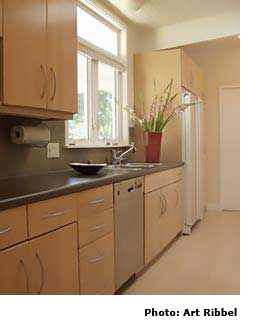
Every kitchen renewal project undertakes one of three escalating tiers of enhancement: restoration, updating, and full remodeling. Each of these possible choices requires different budgets and degrees of planning and, especially at the full-remodel level, can have a very dramatic impact on the original appearance and feeling of the house.

Restoration: Strictly maintaining the original concept and materials. This approach involves trying to restore the kitchen to it original condition. This might include refurbishing the wood paneling or replacing it with new paneling; sanding and repainting the cabinetry; replacing the speckled Formica countertops with ones that closely match the original; installing new linoleum tiles on the floor; and restoring the original appliances, or replacing them with restored ones from the same era.

Updating: Renewing the original concepts and materials. This approach may involve refacing or replacing the cabinets; and replacing countertops with compatible materials, such as granite, concrete, or even a contemporary version of Formica. Appliances may be replaced with contemporary ones that have clean, simple lines compatible with the Eichler concept. Old globe lights may be retained, or may be replaced with something more modern and energy efficient, such as low-voltage halogen track lighting.

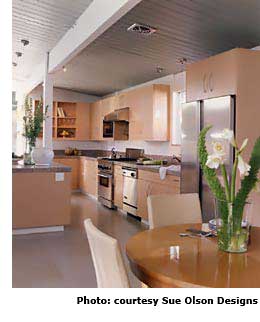
Full remodel: Replacing the original concepts and materials with compatible contemporary ones, and rework the space. This might include completely gutting the kitchen and creating a new footprint. Many Eichler owners today are looking to open up their living spaces even more than they already are. If the kitchen is right next to the boiler room, they may expand into that space; if next to the living room, they may remove the wall into the living room. Some remodels may also involve making a new island in the middle of the kitchen, so that it "floats" in the space.

contemporary kitchen view

WHAT ABOUT RESALE?

It is also wise to be aware of the implications of a remodeled kitchen on resale value. The appearance of the kitchen is of paramount importance when it comes time to re-sell, according to Loni Nagwani of Century 21 El Camino in Sunnyvale, an Eichler owner and specialist in Eichler real estate. "Eichler resale value can be really cosmetic," she pointed out. "A laminate counter, for instance, is really great for resale value in an Eichler."

If you anticipate selling your home in the near future and need to upgrade your kitchen, "you should do it a little less expensively than if you are doing it for yourself," Nagwani said. On the other hand, if you are remodeling for yourself, she added, "You should make yourself happy first and make it the way you want it. You will always get your money back when you re-sell." Furthermore, said Nagwani, if you are getting ready to put your home on the market and are lucky enough to still have an original kitchen intact, it may be "better to do nothing" -- other than basic cleaning and staging -- before marketing. "People would rather you did nothing than to do something" counter to the Eichler concept, she pointed out.

Some buyers, especially designers and architects, are looking for a clean slate with which to make their own design statement, and they oftentimes are willing to pay extra for the chance to do so. While a high-end and beautifully remodeled kitchen is certainly a plus in the minds of many prospective buyers, it is not necessarily what most of them are looking for. If you are going to upgrade or remodel and are concerned about resale value, Nagwani has found that it is best to "stay with modern and stay away from traditional, like French country stuff. With modern design, and its clean and simple lines, you won't ruin the resale value. However, if you go with a traditional kitchen, you can actually reverse some of the value of the home."


DO I NEED AN ARCHITECT OR A DESIGNER?

ron key of key construction

The decision of whether or not to use an architect, a designer, or both, depends on what you are trying to accomplish with your kitchen upgrade. Architects conceptualize, plan, and develop designs for the construction and renovation of commercial, institutional, industrial, and residential buildings and other structures. Often, they will also coordinate and administer many aspects of construction, including field review and inspection as well as preparing contracts and various other documents. Architects go through formal schooling and must be licensed by the state in order to do business.

According to Ron Key, head of Ron Key Construction in Mountain View, you "do not need an architect for most residential projects," but if your purpose is to make a statement, then "go with an architect or an interior or kitchen designer." Key also cautions that many architects are not equipped to do budgeting. As a result, some homeowners can find themselves in a situation where they have sophisticated, professionally produced plans in hand, but insufficient budget to complete the project. On the other hand, if you are planning to move a load-bearing wall or do anything with seismic implications, then perhaps one should consider an architect, since designers are not allowed to do anything that is considered structural. "Architects are specialists in creating the spaces people want to live and work in," added Sue Olson. "As we know, Eichler used several architects throughout his career and their talents and vision can be clearly seen in each and every Eichler they designed."

Interior or kitchen designers can be an invaluable resource for help in remodeling Eichler kitchens. A good designer is an expert in space utilization, functionality, aesthetics, and materials. An experienced designer is also trained in listening to his or her customers and in helping them translate their needs into a project plan. According to Olson, "Most people have junked up their Eichlers. That's why they come to me -- to unclutter their home and keep the lines nice and clean and open." They also want more counter space and room for storage. This can be accomplished with the right combination of design and space planning, cabinets, counters, lighting, and other materials. In addition, designers that have been certified by the state of California, bearing the title "Certified Interior Designer," have been required to pass an exam regarding California building code regulations, and thus can bring additional expertise to the design process.

sue olsen

But it all begins with a plan, and the importance of having a strategy in place cannot be overemphasized -- especially in light of the openness of the Eichler floor plan. Olsen states that while it is not essential to remodel the rest of the home when doing the kitchen, "you need a master plan" to ensure that it all flows and works together.

Chris Chidester, Senior Design Manager for Atherton Kitchen Design Studio of Redwood City, finds that using a designer -- and one with Eichler experience -- is important because it will help you avoid mistakes. "Eichler homes have restrictions that other homes do not," says Chidester. "Traditional designers do not realize you just cannot drill into the floors and ceilings, and they may not understand how to preserve the integrity of Eichler's original designs." He also believes that planning a kitchen remodel should be fun and not stressful. "Most clients are initially overwhelmed and do not know where to start." To counteract this, he cautions homeowners to avoid getting distracted by initially trying to make decisions about cabinet styles, colors, or countertop materials rather than looking at the fundamentals.

"Our design consultations are free of charge and structured so that we break things down to the basics of space planning," adds Chidester. "Working in our kitchen showroom and using our 3-D software, we work with clients to determine the location of the cabinets and appliances." Other details will flow from those initial decisions. The most important thing to remember is that form follows function. If the space is functional, it can be filled with any combination of color and materials.


ARE YOU READY TO ANSWER SOME KEY QUESTIONS?

When homeowners approach a kitchen renewal project, early in the process it is important to put pen to paper and note a few important considerations. There are several questions to ask yourself as you navigate through the planning process. For example:

How long do I plan to live in my home? If you plan to stay in your Eichler permanently, your approach and budget may be very different than if you expect to move away in a few years. If you plan to sell soon, you may want to focus on cosmetic changes, such as painting the cabinets; replacing the old Formica with new, more contemporary looking Formica; and installing modest appliances. If you plan to remain in the home for a long time (say, more than five years), extensive upgrading or remodeling may be more appropriate.

How do I want to use the space? If you envision the space being used for helping your children with schoolwork, it may call for a different approach than if you intend to entertain large groups. It is also customary in Europe for the laundry facilities to be located in the kitchen. If this approach is important to you, it needs to be taken into account upfront.

How much do I want to spend? One of earliest decisions that should be made is the budget. While budgets are certainly subject to change and revision during the remodeling process, it is very important to begin with a budget in mind. From this figure, you can work with your designer and contractor to estimate the costs of various options, adjusting where needed to arrive at a comfortable combination of quality and price. A homeowner with $5,000 to spend may choose to reface the cabinets and replace the countertops with newer Formica. Someone with $15,000 may use higher-grade materials for the countertops and perhaps also install all new appliances. With a budget of $50,000 and higher, walls may be moved and the footprint of the kitchen changed entirely.

Should I upgrade or do a full remodel? What approach is best for me? This involves thinking through whether it makes more sense to restore, to upgrade, or to fully remodel the kitchen by gutting it and creating a new space. This decision will be based on a whole host of considerations, including needs around budget and timing.

Is cooking with gas important, and do I want an exhaust hood? Some cooks prefer gas, especially professional chefs or those involved in stir-fry cooking, where the greater control and higher heat is important. It is more difficult to run gas lines into Eichlers, since they are on slab and do not have crawl spaces or attics, but it is not impossible. Gas lines can be run over the roof or underneath the overhangs. This is also the best time to think about whether or not you want to add a hood for venting kitchen odors. Ron Key observes that "the majority of our kitchen remodel clients dislike their original exhaust fans, since they are small and mounted in the ceiling. Hoods are a real improvement because they cover your entire cooking area and are made of metal. It is much easier to clean grease off of a metal hood than off of your ceiling." In some areas, code may require the addition of a hood.

Should I upgrade the insulation and utilities at the same time? Remodeling is also the perfect time to add insulation, bring the electrical system up to code, and check out the domestic water lines. Some Eichler owners today are replacing their wood paneling with sheetrock and insulation, due to safety and other issues. The old wood paneling is much more vulnerable in a fire than sheetrock, and it is not insulated. The old wood paneling, he says, is much more vulnerable in a fire than sheet rock, and it is not insulated. For safety reasons alone, homeowners may want to consider replacing the paneling with sheet rock. However, there are aesthetic considerations to take into account here. Most original Eichlers were built with paneled walls, and it is still preferred by many owners and want-to-be ones as well.

Christopher Gay of AAA Christopher Electric

Some contractors also suggest conducting professional pressure tests on both the domestic water and radiant-heating systems to assure that they are leak-free and in proper order, though this is optional and depends on the situation. Key points out that it may not be necessary for basic kitchen remodels unless you suspect there is a problem. On the other hand, Key says, if you are doing a radical remodel and will be jack-hammering your concrete, "we would recommend testing -- it is just a prudent thing to do. You may have a leak and not know it."

There is also the electrical system to consider. When Eichler homes were originally built, the need for power was much more modest, especially in terms of kitchen appliances. Microwave ovens or professional-grade double convection ovens were yet to be developed for home use. But the future is now. As a result, electrical systems certainly need to be upgraded as part of a kitchen. "At the time Eichler built, code was very different, and it was common for several rooms or areas to be wired on the same circuit," pointed out Christopher Gay of AAA Christopher Electric, Inc. of Redwood City, an electrical firm experienced in working with Eichlers. "Today's code requires more dedicated circuits in order to keep up with newer technology."

Gay also indicated that "the old two-pronged electrical outlets were not grounded. For remodels that involve pulling the walls, code now requires electrical updating to include replacing the old outlets with three-pronged, grounded outlets." Ground fault circuit interrupters, or "GFCI" outlets, are also required for areas near water, such as kitchen, bathrooms, garages, and outdoors. These prevent electrical shock by interrupting the circuit.

In conclusion, Gay said, "Remodeling projects also provide a great opportunity to add further enhancements, such as wiring for the new technologies, like computer networking, home entertainment systems, and so forth."

When it's time for kitchen renewal, consider the Eichler Network service team:


Five Common
Mistakes to Avoid

No one is perfect. Everybody makes mistakes. The trick is to minimize the mistakes, especially when they can cost one time and money. Here are some tips for avoiding common mistakes when upgrading or remodeling your Eichler kitchen.

Get to know your home. If you purchased your home recently, live in the home for a while and really get to 'know' it before embarking on a remodel. This is especially true in terms of how you want to use the space. For those who have owned their homes for many years, this would not be an issue.

Do your research. Be sure to do your research well in advance of beginning the project. Understand all the options available, and the expected cost of each one. It would be a shame to find out after your remodel is complete that "if only I had known about those halogen track lights, or that cork flooring..."

Plan ahead. Have all decisions finalized and all fixtures and materials on site before work begins. Failure to do so can delay work while construction crews wait for back-ordered items to arrive. It could even lead to expensive change orders in the middle of the project. When ordering materials and appliances, allow a time cushion to account for the possibility that something may arrive damaged and may need to be replaced.

Build in a financial cushion for the unexpected. Ron Key of Key Construction emphasizes that "even if the contractor bids and designs the job correctly, you should build in a budgetary cushion of around 15 percent to account for the unexpected. "In the past, for the most part, we found that budgets increased because people changed their minds and added things as the work progressed," key said. But today, something else is on the rise. "While we used to find most radiant and electrical systems were working just fine during our remodel projects, Eichlers are getting older, and as a result, we are seeing an increase in whole system failures. Your electrical system could be rotted and you may not even know it until the walls are opened up." Homeowners should be aware that whole-house upgrades could be expensive. Upgrading an entire electrical system can add as much as $15,000 to $20,000 to your project cost.

Anticipate other work that can be done. Work with your contractor to anticipate other repairs or changes that may also make sense to do in conjunction with your kitchen improvements. For example, code may require certain upgrades to the electrical system, such as replacing old outlets with new ones. However, you may also want to add wiring for extra phone lines or high-speed Internet connections.


Selecting a
General Contractor

Selecting the right general contractor can be a challenge. We all hope to find someone that is honest, thoughtful, easy to work with, skilled, and reasonably priced. When interviewing a contractor, here are some questions to consider:

Do they have experience working on Eichlers? While there are many capable contractors, do you really want your home to be the guinea pig for someone to learn on? Eichlers are unusual enough that it may well be worth it to find a contractor with plenty of Eichler experience.

What do their former customers say about them? Be sure to check references. Call as many of the contractor's previous customers as it takes to get a good flavor for what they have to say about the entire remodeling experience.

Do they allow you to go onsite to current jobs and talk to their customers? Contractors that are honest and above board will not hesitate to allow you to accompany them to current job sites. If they do a good job for their customers, they will not be afraid to bring you to current job sites and introduce you to their clients.

Are they responsive? Upgrading or remodeling can be a lengthy process and it is important to find someone that is responsive and prompt in returning phone calls and answering any questions you may have.

Does their bid seem understandable and reasonable, and are all associated costs clearly broken down? It is much easier to discuss the job with your contractor, and to later refine the plan, if every detail is in writing.

Are they licensed and in good standing with the California Contractor's State License Board? You should check the status of their contractors license with the board. You can do this online at www.cslb.ca.gov, or by phone at 1-800-321-2752.


See other Eichler House Doctor stories


dura-foam solar center
eichler solutions

Top of Page


pixel

The Eichler Network
info@eichlernetwork.com