
 |
DESERT DELIGHTS
Stunning sights and rich legacy -- climb aboard
our grand tour of the best of Palm Springs modern
From the pages of CA-Modern magazine
By Dave Weinstein
Photographs by John Eng and Adriene Biondo (except as noted)
When Jim Isermann bought his steel home nine years ago, it had plywood in the
windows and a junked car in the driveway. Today it's a tourist attraction. "I
could have this on a tour every weekend, if I wanted to," Isermann says.
Isermann lives in an all-steel house designed in 1961 by modern architect Donald
Wexler for the Alexander Construction Company, which built more than 2,000
post-and-beam homes in Palm Springs and vicinity from 1955 to 1965. George and
Robert Alexander brought modern, architect-designed tract homes to Palm Springs,
just as Joe Eichler did in the San Francisco Bay Area.
As opposed to the Bay Area, however, where Eichler and his modern homes had few
followers during the builder's career, modernism took hold in Palm Springs,
which had been a Mecca for modernist architects since the 1930s.
In the 1920s and '30s, European pioneers R.M. Schindler and Richard Neutra
brought Palm Springs a taste of the International Style. Architects John Porter
Clark, William F. ('Wild Bill') Cody, E. Stewart ('Stew') Williams, and Albert
Frey, who settled in town in the '30s and '40s, created their own regional
style, 'Desert Modernism,' by using local rock, concrete blocks, and metal, and
paying attention to the desert's stark vistas and light.
Modern masters from Los Angeles popped in, including John Lautner and Craig
Ellwood, who designed homes that every fan of modernism knows. Paul R. Williams
also contributed to architecture in the desert with his partner A. Quincy Jones,
who later made his mark as one of Eichler's architects. Hollywood stars enjoyed
the architecture, city fathers embraced it, and by the mid-1950s, the middle
class adopted it too. The Alexanders brought modernism for the masses to the
desert and other builders tagged along.
Touring Palm Springs reveals more than individual buildings. Palm Springs has
one of the largest concentrations of modern architecture in the country, some of
the purest examples of International Style to the wackiest examples of
Jetson-esque commercial buildings called 'googie.'
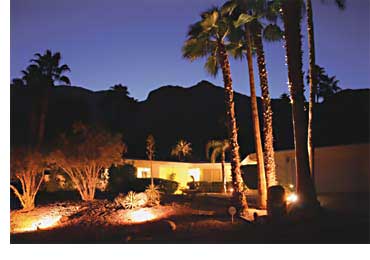
The architecture celebrates the desert by opening up to it, using the sun to
paint patterns, and miraculously making sure that every house appears to have
nothing for a neighbor but the mountains themselves. "It's really living with
the desert," historian Tony Merchell says when asked to define Desert Modern.
Merchell, who is active with the Palm Springs Modern Committee, also manages two
modern motels in nearby Desert Hot Springs.
Whatever Desert Modernism is, you'll spot it as soon as you enter town, whether
by air (Wexler designed the Palm Springs Airport) or by road (Frey's wing-like
Tramway Gas Station, a collaboration with then-partner Robson Chambers, today is
the visitor center). Behind the visitor center is the Aerial Tramway, which
lifts you high up Mount Jacinto -- providing incredible views, a respite from
the desert heat, and the opportunity to examine Frey's desert Tramway lift
station, and Stew William's mountain top station.
The visitor center sell the Modern Committee's 'A Map of Palm Springs Modern,'
which provides a superb overview of the city's gems and provides some context --
but not much. For more, try PS Modern Tours, run by Robert Imber, who provides a
chatty and informed three-hour, 35-mile tourmobile that reveals a passion for
architecture that's contagious. Imber hits the hot spots and some hideaways, and
says: "It barely touches the tip of the iceberg of what's here."
|
The Isermann house is one of seven all-steel homes (top) built in 1961 by the
Alexander company. Owner Jim Isermann (above) visits with architect Donald
Wexler.
Photo: Barry Sturgill
Above: Three prime examples from among the more than 2,000 Alexander tract homes
in Palm Springs.
Architect Bill Krisel's 'House of Tomorrow' a.k.a. the 'Elvis Honeymoon
Hideaway.' Photo: Dave Weinstein
|
To Imber, Palm Springs modern architecture is beyond cool. It's beautiful and
important and worth extended contemplation He urges clients to return on their
own to the buildings the tour visits, then stand and watch as the sun moves
across the sky and buildings change in the light. "The true architecture of the
desert really evolves from the lighting and textures and colors and essence of
the desert," Imber says.
That explains the brise soleil ('broken sun') screens of patterned concrete
blocks, textured concrete block walls, notched corners found in many public
buildings, walls of heavily scored concrete or heavily textured and deeply
colored local rock. Broad awnings provide shade, and most houses have pools and
avoid direct summer rays. But mid-century desert architecture was not designed
for intense heat. Insulation was poor. Until recently many homes were vacation
residences abandoned from late spring to mid-fall, and most still are.
Imber delights in the variety of styles that can be made to work in the desert.
No place illustrates that better than a hillside spot on West Cielo Drive in the
Little Tuscany Estates neighborhood. On one side of the road is Ellwood's
classic Palevsky house, white and minimalist, dealing with the desert by
challenging it. On the other is Stew Williams' Edris house, stone-walled and
playful, which seems to grow from the desert.
Little Tuscany and the nearby neighborhood of Las Palmas contain many modern
homes worth a look. Julius Shulman's twilight photo of Neutra's Kaufmann house
from 1946, showing Mrs. Kaufmann by the pool, helped define modern architecture
as sybaritic and serene. What you'll see today, hidden behind a stone wall and
foliage, are just enough cantilevers to tempt.
One amusing house in Las Palmas was designed by the Alexanders' main architect,
Bill Krisel, of the Los Angeles firm Palmer and Krisel, Inc. The house, with its
polygonal bedroom floating beneath bat wings, was originally built as a spec
house. But Bob Alexander's wife fell in love with the 'House of Tomorrow,' so
she and her husband moved in. Today the house is better known for its connection
with Elvis, who spent his honeymoon there. The 'Elvis Honeymoon Hideaway' is
opened for concerts and other events.
Imber starts his tour in the center of town, at Tahquitz and Palm Canyon drives,
where one of the earliest modern monuments can be spotted. All that will remain
of Lloyd Wright's 1924 Oasis Hotel after a promised remodel will be its bell
tower and remnants of the original shops. The hotel was built when the town was
just developing as a vacation draw around the Cahuilla Indian's hot springs.
Wright, the son of Frank Lloyd Wright, had a distinguished career all his own.
Few pre-World War II modern landmarks remain intact or easily viewed. One that
does is the elegant Ship of the Desert, a Streamline Moderne home designed in
the early 1930s by Los Angeles architects Adrian Wilson and Earl Webster.
Another pre-war gem is Neutra's Grace Miller house, an unpretentious but elegant
series of intersecting rectangles that can be seen on Indian Canyon Drive.
Frey's Movie Colony Inn, also from the '30s, was built when Hollywood stars were
making Palm Springs their own.
Palm Springs was taken over by the military during the war, but sprung to life
immediately after. Bill Cody designed the angular Del Marcos Hotel in 1946, the
same year Paul Williams and Quincy Jones designed the Palm Springs Tennis Club.
Golf had not yet supplanted tennis. 1946 also saw the Kaufmann house. In 1947
Stew Williams, who moved to Palm Springs in 1946, did his home for Sinatra.
| |
Modernism had arrived. It flourished in the early '50s when many of the public
and commercial buildings that still give Palm Springs its modern character were
created. Palm Springs was becoming a city. Soon it would have houses for its
workers.
George and Robert Alexander, father and son, arrived from Los Angeles in 1955.
The Alexander's first project in the desert was the Ocotillo Lodge at the south
end of town. Next to it came their first subdivision, Twin Palms Estates. It
established the Alexander formula -- square houses up to 2,000 square feet that
look long and rectangular thanks to a street frontage that fools the eye.
"Parking, breezeway, windows, wall," is how Imber puts it. The open breezeway
between carport and house is an Alexander trademark that was much copied. So was
the Alexanders' use of concrete screens and stone walls to enliven facades.
But nothing so defines Alexanders as their jazzy roofs. Flat, low gabled,
butterfly or zigzag, the roofs add variety and a touch of fun to neighborhoods
that are composed of essentially the same house. No one visiting an Alexander
neighborhood should neglect the stone walls or stone facades, or concrete
screens and walls. Many are works of art. The Alexanders' most unique
development was a group of seven steel homes designed in 1961. The goal was to
build an entire neighborhood, but the price of steel rose and the project died.
The neighborhood is a Palm Springs historic district.
By the 1970s, Palm Springs was on the skids. Stew Williams blamed the city's
rejection of his proposed modern downtown master plan. Others blamed the growth
of gated golf club communities 'down valley' in Rancho Mirage and Palm Desert.
Modern buildings continued to be built -- including such landmarks as John
Lautner's flying saucer home for Bob Hope, and Cody's beautiful St. Theresa
Catholic Church. But others were ignored. Imber remembers when Neutra's Miller
residence housed derelicts.
By the late 1990s, however, Palm Springs was back -- thanks in part to its
modern architecture. Several major remodels -- of the Kaufmann house, the Loewy
house -- reminded people of the architecture's beauty. A successful fight to
preserve Frey's Tramway gas station and his fire station buoyed mid-century
fans. Motels are cleaning themselves up and installing Eames chairs and Noguchi
tables. Shops selling vintage modern can be found everywhere.
Jim Isermann, a member of the city's Historic Site Preservation Board, says,
"When I started there were only six people in town who cared. Now there are a
ton of people." But several of the city's modern landmarks remain in danger --
and may be beyond rescue. Imber shudders when he walks past Paul R. Williams'
and Quincy Jones' Town and Country Center, a retail plaza that has lost its
looks.
Isermann is encouraged by some of the younger architects, like O'Donnell
Escalante Architects, who are creating buildings that are rooted in the desert
tradition. "We are getting wonderful contemporary designs," he says, "based on
mid-century principles."
Mapping Out Your Own PS Tour
There is much more to be seen in Palm Springs and vicinity than can be covered
in one article. Palm Springs has many neighborhoods filled with Alexanders and
other modern tract homes. 'Down valley' towns, including Rancho Mirage, Palm
Desert, Indio, and La Quinta, contain modern homes, though most hide in gated
communities. Desert Hot Springs, north of Palm Springs, is best appreciated for
its refurbished retro motels.
North End of Palm Springs:
- Tramway Gas Station visitor center, North Palm Canyon Drive at Tramway
Road.
- Donald Wexler's seven Alexander steel houses can be found on Sunnyview
Drive and Molino Road, half a mile from the Tramway Gas Station.
- Racquet Club Road Estates, an Alexander neighborhood, is a few blocks
south, on both sides of Raquet Club Road between Indian Canyon Drive and
Caballeros Drive.
- Richard Neutra's Miller house can be spotted nearby, behind a fence at
2311 North Indian Canyon Drive.
- A half mile to the southwest takes you to Little Tuscany Estates, a
boulder-strewn edge of the mountain that features Stew Williams' Edris house
(1030 W. Cielo Dr.) and Craig Ellwood's Palevsky house (1021 W. Cielo). Many
other fine modern homes can be spotted in this neighborhood, including the
iconic Kauffman house by Neutra (476 Vista Chino).
- Las Palmas Estates, in lower lying land to the south, includes many
wonderful Alexanders, including the Elvis Honeymoon Hideaway on Ladera
Circle.
- On your way to downtown, swing by the Stew Williams' Sinatra house
(1148 Alejo). If the gate is open you'll get a peek.
|
Downtown Palm Springs:
- The tower and original shops of the Oasis Hotel can be spotted on the
west side of Palm Canyon Drive near Tahquitz Canyon Drive.
- Palm Springs Tennis Club, by Paul Williams and Quincy Jones, has been
remodeled but is worth visiting, at 701 West Baristo Road, west of
downtown.
- The nearby Palm Springs Art Museum by Stew Williams is a must-see. 101
Museum Drive.
- Albert Frey house. The museum owns the second house Frey built for
himself but, according to the terms of his will, it is open to scholars only.
Get a look from the end of Arenas Road.
Civic Center:
- The former Police building (3111 East Tahquitz Canyon), by John Porter
Clark and Albert Frey, and City Hall, by a consortium led by Williams, are
across from the airport.
- Not far away are two wonderful interiors by William Cody, the Palm
Springs Library, 300 South Sunrise Way, and St. Theresa's Catholic Church, 2800
East. Ramon Road
South:
- The Streamline Moderne Ship of the Desert, on Camino Monte, is a
landmark that can be spotted from several streets, including Liliana Drive.
- Lautner's flying saucer-like house for Bob Hope can only be viewed from
a distance. Look to the hills from East Palm Canyon Drive (Highway 111) where it
crosses Cherokee.
- The first Alexander neighborhood, Twin Palms Estates, can be found
behind the Alexander's Ocotillo Lodge, at East Palm Canyon and Arquilla Road.
- Don't miss Green Fairway Estates, a tract designed by Don Wexler and built by the Alexanders, with some of the finest stone walls and wackiest facades in town, on Lakeside Drive and vicinity in the Tahquitz Creek Gold Resort.
- Haleiwa Joe's Seafood Grill is a few miles south, 69934 Highway 111,
Rancho Mirage. But architect Ken Kellogg's restaurant, which architectural
historian Tony Merchell sees as "some kind of prehistoric crustacean," is not to
be missed.
|
Elegant prewar modern landmark Ship of the Desert.
Alpine A-frame from Las Palmas Estates.
Architect Stew Williams' stone-walled Edris house.
Palm Springs City Hall.
The quirky-angled entrance to the Del Marcos Hotel.
Photo: Dave Weinstein
|
Modern Lodging:
Palm Springs has many architecturally distinctive, or at least period, motels,
with furnishings that range from thrift store modern to museum pieces. Many can
be found along East Palm Canyon Drive just south of downtown, including the
tiki-themed Caliente Tropics Resort (411 E. Palm Canyon Dr., 760-327-1391).
Others include:
-
Century Palm
Springs, an Alexander apartment house, has been turned into an inn. (598
Grenfall Road,760-323-9966)
- The Del
Marcos, Bill Cody's first commission in town, set the tone for post-war
modern motels. The motel also has a wonderful Alexander home available for rent.
(225 W. Baristo Road, 1-800-676-1214)
- The Movie
Colony Hotel, designed by Albert Frey. (726 N. Indian Canyon Drive,
1-888-953-5700).
- The Orbit In,
perhaps the highest end of the retro resorts. You can see Albert Frey's house
from the Frey Room's outdoor shower. (562 W. Arenas Road, 1-877-996-7248) The
architect was Herbert Bruns, who also designed the Desert Riviera (610
E. Palm Canyon Dr.)
- The Beat Hotel
(as in 'beatnik') and the Desert Hot Springs Motel (also called the Lautner Motel) share the
same ownership in Desert Hot Springs. The Lautner motel is especially unique,
four units of angular steel that develop a very special relationship with the
desert. Tony Merchell is manager. (760-288-2280).
- Miracle Manor is a 1948 motel remodeled by architect Michael Rotondi.
(12589 Reposo Way, Desert Hot Springs, 877-329-6641).
Touring and Events:
See other Palm Springs Stories
|
|
|