

GREEN FAIRWAY ESTATES
An exotic, quirky hideaway, this Palm Springs
tract recently rediscovered its Alexander roots
From the pages of CA-Modern magazine
By Jack Levitan
Modern architecture is known for its honesty. A modern tract house may be
elegant and livable -- sybaritic even. But it rarely dresses in exotic clothing.
That's why the 35 or so houses that make up Green Fairway Estates, with facades
that recall Hawaii or ancient pueblos, picturesque rock walls inside and out,
and floor-to-ceiling 'Hollywood Regency' mirrors, come as a surprise. It also
helps that they are so hidden away that many longtime residents of Palm Springs
have never seen nor heard of them.
Palm Springs has some colorful neighborhoods, says Martin Fletcher, one of Green
Fairway Estates' biggest fans. But, he says, "I think it's the quirkiest of the
bunch."
In many ways, however, the houses are quintessential Palm Springs. They were
built by the Alexander Construction Company, which gave the city its defining
modern tracts, and designed at least in part by Donald Wexler, one of the town's
best-known architects. Green Fairway Estates could be his least-known project.
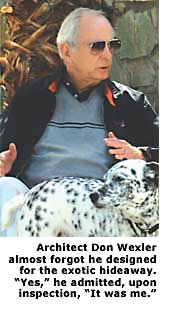
It took some prodding, in fact, before Wexler could recall the place.
Wexler recalls the floor plans clearly as being his design, he said during a
recent interview. He also takes credit for the detailing of the low-gabled
model, "the posts, the way the beams are handled, the roof detail," he said. But
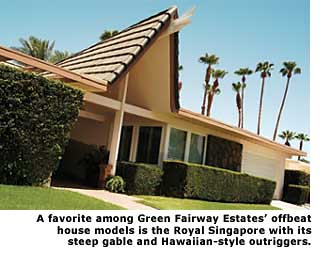
then he looked at a photo of the Royal Singapore with its outrigger. "This I
can't even imagine myself doing. It's possible. Maybe it's something the
Alexanders wanted, and I just did some sketches they worked from."
Green Fairway Estates' genesis was even more mysterious when Fletcher, a
collector of modern furnishings who wanted to add a house to his collection,
first tooled through the neighborhood. He didn't know the houses were by George
and Robert Alexander, and had no idea they were by Wexler, who is generally
credited with designing only one group of Alexander houses, the now-famous seven
steel homes at the north end of town. Wexler is also known for the purity of his
design. But there is little pure about Green Fairway.
"Who built these crazy houses with these huge A-frames?" Fletcher wondered. He
found a clue at Royal Hawaiian Estates, a cluster of poolside Tiki condos on
South Palm Canyon Drive designed by Wexler and his then-partner, Rick Harrison.
Wexler says it was Harrison who provided the tropical touch.
"The Hawaiian motif is what gave it away for me," says Fletcher, who got on the
phone to Wexler to confirm his authorship of Green Fairway Estates. "He said,
'Don't get your hopes up,' " Fletcher says. "He drove by, he said, 'Yes. It was
me who did those houses.'" The attribution was confirmed when Fletcher came upon
the original sales brochure. "Designed by Donald A. Wexler, A.I.A., Palm
Springs," it said.
Residents love their neighborhood for its sense of repose -- at the southern end
of town, away from the bustle, and surrounded by a public golf course -- no
membership required. The golf course, says Ernie Rapalee, "is everybody's
backyard." And they love Green Fairway's uniqueness. "It's not cookie-cutter
homes," says Penny Tappeiner, who's lived in the neighborhood five years with
her husband Bruce. "Everyone here is an individual and our homes are
individual."
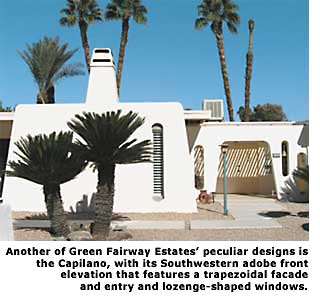
Nine models of three- and four-bedroom homes make up the neighborhood -- the St.
Andrews, Gleneagles, Capilano, Royal Melbourne, and the Royal Singapore with
four bedrooms, three baths. "Live 'big' in palm Springs," the Alexanders urged.
The houses were built in 1964 and 1965, and work may have continued after the
Alexanders and their wives died in a plane crash in November 1965.
There are houses with flat roofs and sloped roofs, low gables and steep gables
that end in Hawaiian-style outriggers -- though few outriggers remain intact.
There are trapezoidal facades that suggest Southwestern adobes, with trapezoidal
entries and odd, lozenge-shaped windows -- some filled in with stained glass.
Board-and-batten siding -- the batten an inch thick to create patterns of shadow
in the hot desert glare -- provides a western touch to some facades.

|
 |
But most of all there are stones. The neighborhood is an art gallery of
stonework, each wall or façade different, much of it looking like
mortar-less drywall -- though, of course, it's not. The stonework is among the
best the desert has to offer. No one can name the masons who constructed these
walls. "I would love to know! I think this is one of the real strengths of this
neighborhood," Fletcher says. "Particularly the units with the blue-gray rock.
Just love it."
Walking through the neighborhood in the evening -- with golden light hitting the
rocks, the moon-like landscape with its sculptural ocotillo, barrel cacti and
tight-cropped cypress, and several varieties of palm -- it's easy to see why
Fletcher produced a neighborhood website that urged visitors to stop and stare.
"Your short trip down Lakeside Drive will be nothing short of a trip around the
world," he promises.
Inside the houses are just as lively. The plan is an H -- an entry in the
middle, bedrooms to one side, living areas to the other. You can step into the
house and step right out again -- immediately beyond the front door is a wall of
glass that opens onto a backyard atrium, with glass on three sides and the golf
course on the fourth.
"When I first saw the house," says Ernie Rapalee, who lives in an outrigger, "I
said, this is so wild!"
Oddities abound. Why are there paired front doors? Why is the entry hall a step
higher than the living and sleeping areas? Why do the interior doors reach from
floor to ceiling? Why is the wall of sliding closets in the bedroom fully
mirrored? Penny Tappeiner wonders about that one. "Who wants to look at
themselves?" she asked.
Among the homes' indulgences are a walk-in sunken tub (called "Roman tubs" by
the locals) with a glass doorway onto its own private garden for quick access to
the swimming pool.
The stonework that decorates most houses is repeated inside, with a wall of
stone protecting a free-floating gas fireplace. Many have been removed. Today,
original interior stonework and fireplaces are prized. Fletcher and his partner,
Cody Stoughton, say people have made offers on theirs.
Like all Palm Springs neighborhoods, Green Fairway Estates mixes year-rounders
with part-timers -- and even many of the year-rounders don't stay the entire
summer. That makes it hard to build community, residents say -- but not
impossible. "There are not enough of us here to socialize," says Babs Rapalee,
who's lived in the neighborhood with Ernie since 1998. "If you're here during
the summer," neighbor Vince Houghteling adds, "it gets more neighborly for some
reason."
But no one's complaining. Few people pull their drapes because lots are private,
and some don't lock their doors when they're gone -- although there was a recent
rash of golf cart thefts. Bruce Tappeiner, a retired muffler shop owner, has
become the neighborhood handyman and artisan, crafting many a neighbor's
modern-style gate. "There are no kids in the neighborhood," Penny Tappeiner
says, "nor do we want any."
"Palm Springs is mainly retired, or gay men," Stoughton says.
"I like it because we're friendly," Penny says, "but people are not nosy."
Fifteen to 20 years ago things were livelier, Bruce Tappeiner says. Folks called
themselves 'the Lakeside Gang' and threw a lively annual party. At a recent
get-together to show a visitor around the neighborhood, Tappeiner vowed to renew
the tradition. "This is a little core group of the new Lakeside Gang right here,
and we're going to expand."
The get-together turned into a neighborhood tour of several houses, everyone
admiring each others' improvements. They also admired the variety in the
original detailing and arrangements of space. "I'll be damned! All sorts of
subtle differences," Tappeiner said. "All these houses are different!"
Green Fairway Estates makes up 5300 E. block of Lakeside Drive and 2400 S. block
of Pebble Beach Drive. The neighborhood website, created by Martin Fletcher, is www.desertmodernism.com/greenfairway.html.
Photos: Barry Sturgill, Dave Weinstein
|