

WORK IN PROGRESS
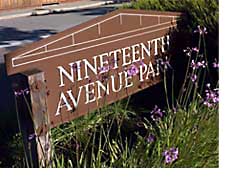
Nineteenth Avenue Park -- building community
in a hidden Eichler enclave of urban San Mateo
From the pages of CA-Modern magazine
By Dave Weinstein
By all accounts, the quiet Eichler enclave of Nineteenth Avenue Park has been a marvelous place to live since folks first arrived 55 years ago.
"It was awesome," says Sharon Tallman, who grew up in the San Mateo neighborhood from age two, briefly left, but returned to raise three children there herself.
She remembers neighborhood baseball games and talent shows, with parents hauling pianos into their driveways to better entertain the community. "We had barbecues outside for no reason," says Rita Balliet, an original owner and Sharon's lifelong friend.
"There were patio parties and block parties," recalls Dorothy Ragent, who moved to Nineteenth Avenue Park with her husband Boris in 1956. "Kids would play out on the street till five or six in the evening."
And when there were threats, the neighborhood came together. Plans for a cement plant were quickly scotched, Dorothy Ragent remembers. "We took it upon ourselves to fight it," she says. "It helped that Roy Archibald" -- San Mateo's popular mayor back then -- "lived here."
Nor did the neighborhood ever turn surly. This is a place, after all, where longtime resident Dorothy Sussli welcomes newcomers and looks after her elderly neighbors, where car collector Joe Cuevas offers free advice to neighbors with car fetishes of their own, and where David and Linda Koehn, walking the neighborhood shortly after moving in, were invited inside by folks whose home they stopped to admire. "That was so kind," David says. "It was a real memorable moment for us."
Still, when Hai Yang, a young scientist who was born and raised in South China, moved to Nineteenth Avenue Park a year ago, he was surprised at the lack of spirit. "Not many people were enthusiastic about the community," he says.
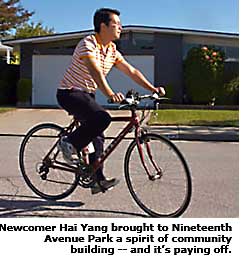
The first 19th Avenue Park Neighborhood Association meeting he attended had folks from only a dozen families in attendance -- in a neighborhood of almost 240 homes. "Sometimes," he says, "neighbors don't know their neighbors." He adds: "In China, people know their neighbors and they help each other."
Yang immediately set about building community -- and his efforts are starting to pay off.
Nineteenth Avenue Park, built from 1953 to 1955 to designs by architects Jones ∓ Emmons, remains something of "a mixed bag," says Koehn, who also arrived last year.
Although many homes still show evidence of having gone through what neighbor Ken White calls "a period of ticky-tackiness," many others have recently been restored or revamped in keeping with the Eichler aesthetic.
Koehn's own home, a landmark because it is one of the first houses you see when entering from Charles Street, is being transformed from an eyesore to something hip, with replacement Eichler siding, an austere water-saving garden -- and a two-story palm tree.
"There are a lot of homes I notice that are in the process," Koehn says. "If you see a lot of homes in process, that's a good sign."
But there's more to the Nineteenth Avenue Park story than the standard newcomers-restore-faded-neighborhood story. To start, the neighborhood is unusual among Eichler tracts in several ways.
It began partly as a blue-collar community, some old-timers say. Eichler neighborhoods tend to be professional and managerial. And from the start, Nineteenth Avenue Park had an unusually large percentage of Asian residents -- during a time when few neighborhoods in the area would sell to Asians.
Also, Nineteenth Avenue Park gradually became one of the most urban of Eichler's neighborhoods, as large shopping centers and mid-rise office parks popped up along its fringe and as the three-lane Bayshore Freeway morphed into Highway 101 and Nineteenth Avenue was supplanted by Highway 92.
Today, the neighborhood is at the crossroads of the San Francisco Peninsula, with two crowded freeways intersecting blocks away, gleaming office towers serving as landmarks, and downtown San Mateo, vibrant and charming as ever, a 25-minute walk away. The Hayward Park Caltrain station, two blocks from the neighborhood, provides a commute alternative -- as do bike paths. Hai Yang, a scientist for a pharmaceutical firm, bikes to work.
Yet, despite its central location, Nineteenth Avenue Park is a bit of a hidden Eichler enclave, less known, less esteemed, with homes less costly, than its siblings in Palo Alto or Sunnyvale, or even up the hill in San Mateo Highlands.
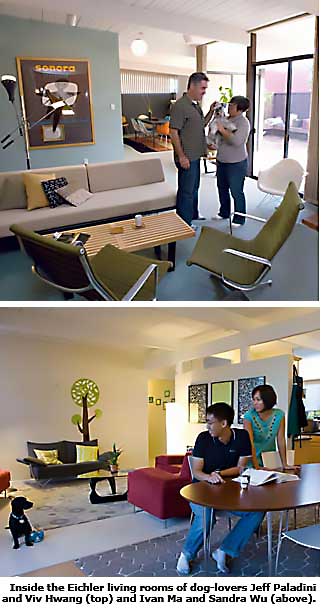
"Are those Eichlers?!" Viv Hwang exclaimed when she spotted the Nineteenth Avenue Park while house hunting with her husband Jeff Paladini. Hwang and Paladini, Eichler enthusiasts for years, were excited by their find -- and by finding out that the homes in Nineteenth Avenue Park were selling for about $300,000 less than homes in the Highlands.
"We made an offer on a teardown in the Highlands that would have cost more than this house," Paladini says of the home they bought eight years ago.
A stroll through Nineteenth Avenue Park reveals a compact neighborhood, roughly rectangular but with gently curving streets, that is protected from through traffic and hidden from the outside world because there are only two streets that lead in and out (although six of the Eichlers face, not into the neighborhood, but out, along one of the boundary streets).
Lots are among the smallest in any Eichler subdivision outside of San Francisco, roughly 5,000 to 5,500 square feet (except for some cul-de-sac and corner lots, some of which approach 10,000 square feet).
Because the neighborhood is set off from its neighbors -- and despite the buzz of traffic from 101 and 92 and of airplane traffic to nearby SFO -- residents praise Nineteenth Avenue Park's quiet. The lack of overhead utility lines adds to the neighborhood's charm. The relative lack of street trees detracts. Original cherry trees planted along several streets died long ago.
There are essentially three original house plans, three-bedroom and four-bedroom layouts, many with an 'all-purpose room' used either for dining or, more commonly, for the TV. Some homes are flat-roofed with a taller section over the main living areas. Others are low gabled. Corner houses have shed roofs over one section, flat roofs over another.
These houses were designed before the Eichler atrium was introduced, but all have terraces opening off living areas and bedrooms.
The neighborhood only has one house that gained a second story, and three or four that were either remodeled or rebuilt to no longer resemble Eichlers. Most of the homes retain their historic looks -- though Colonial shutters and antique-style carriage lamps are common, and projecting bay windows and vinyl siding appear here and there.
A very persuasive garage door salesman appears to have passed through the neighborhood some time ago, as a surprising number of original sliding-garage doors have been replaced with automated ones that sport panels or sunbursts.
Although a couple of years ago one house was converted into what newcomer Ivan Ma called "an Eichler plus a pueblo-style melded together," no one in Nineteenth Avenue Park seems anxious to impose design controls. Neighbors who appreciate the Eichler aesthetic sometimes proselytize to those who do not.
Perhaps 15 percent of the homes are rentals, which account for most of the poorly tended lawns, neighbors say. Ten or more houses serve as board-and-care homes for disabled or elderly people, and at least one houses drug rehab clients.
On the whole, neighbors say, the board-and-care homes are good neighbors, and several have been meticulously restored. But some neighbors, including Paladini, worry that if many more open, Nineteenth Avenue Park could become more of a business district and less a neighborhood of families.
Besides the homes themselves and the convenient location, there is much to love about Nineteenth Avenue Park, residents say. The schools have long been superb. A Trader Joe's grocery is five minutes away. "There's definitely no crime," Koehn says.
And people in the neighborhood have always gotten involved with the wider community. Before buying in the neighborhood, Ken White, who knows everyone in the county through his job as president of the Peninsula Humane Society, asked folks in the know about Nineteenth Avenue Park.
"We were told it is a very engaged neighborhood," he says. "It's always had a neighborhood voice. It was a neighborhood that looks out for its own interests."
Cheryl Hylton, a former teacher and fundraiser for nonprofit organizations, has emerged as the leading neighborhood activist over the past decade. The challenges she has faced arise because one of the neighborhood's greatest pluses -- its central location -- has also turned out to be one of its greatest minuses.
"Because it is such a convenient location, there have been many proposals for development," Yang notes. These have included plans for a large Marriott hotel and for an office park, and plans to widen Delaware Street, which borders the neighborhood.
All those plans proceeded -- but not before Hylton won important concessions.
In the case of Marriott, which in 1997 proposed to greatly enlarge an existing hotel, Hylton said, "Not so fast. You'll be peeking into our neighbors' backyards. We'd like you to do something for us."
"At first, with a straight face, Marriott said their neighborhood mitigation would be a fountain in front of the hotel," Hylton says. Her answer was no. "I said, 'Let's start with [nearby] Concar Park.'" Both Marriott and the city of San Mateo kicked in for park improvements.
"The park was horrific," says Joe Cuevas, whose home across from the park has become a neighborhood landmark because of his collection of classic cars. "We had kids drinking, and transients."
But today, the once weedy and debris-strewn park has become an immaculate play lot that attracts folks from miles around and is the neighborhood's central gathering spots -- thanks to funding and maintenance from the Marriott.
As for the Delaware widening, which was proposed around 2000 and would have pushed the road closer to Eichler homes, increasing noise, and fumes, "I told the city, that doesn't work for us," Hylton says.
Consulting old planning documents, she determined that the city had promised the neighborhood a planting strip between their sidewalk and the street -- a strip that had never been installed. But that wasn't surprising; the sidewalk itself had never been installed. In fact, the entire edge of the neighborhood looked ragged, thanks to a hodge-podge collection of fences, some of them chain-link, Hylton says.
Hylton worked out a deal -- between the neighborhood, the city, and the developer of a nearby office complex -- which had the developer paying for, and the city agreeing to maintain, a handsome fence, a landscaped strip, new trees, and a sidewalk that replaced an informal dirt path.
The neighborhood continues to face development issues, including plans for two office buildings near the Highway 92 off-ramp and Caltrain station, and plans for 'Station Park Green,' a dense retail, office, and 600-unit apartment project on the site of an aging Kmart center.
The neighborhood association doesn't oppose development, but is concerned about density and traffic. "We want some development," says Hai Yang, "but we want good development."
Yang may be a newcomer to the neighborhood, but he has emerged as one of its potent forces, serving as president of the association. "He tapped into a latent desire for people to meet their neighbors," says Viv Hwang.
Yang, an affable man who is turning his large yard into an orchard, has spearheaded such community events as barbecues, parties in the park, cookie parties, and bicycle rides. "It was frustrating at first," he says. "Some people were not interested."
About 30 people attend association meetings. A dozen came to the cookie party. "It's a start," Viv Hwang says. Saul and Angela Lewis, who do get involved with the association, understand why many others do not. Like many of the newcomers, they too have children. "We want to be more involved in the neighborhood but it's hard with three kids," Angela says.
Still, having children makes it easy to meet people. Saul and Angela often bike through the neighborhood, heading for Concar Park, their children buzzing along on their Razor mobiles. They meet neighbors walking dogs and stop to chat with Joe Cuevas. "It's not just rushing to the park," Angela says. "It's enjoying the walk to the park."
Sandra Wu, Ivan Ma's wife, whose backyard has three raised beds of vegetables, has another idea for increasing community involvement -- a neighborhood fruit and vegetable swap. She notes that more and more homes are putting in vegetable gardens and orchards.
Over the years, Nineteenth Avenue Park has had downs as well as ups.
The first down came early when a dozen or more houses began to settle, their concrete slabs cracking. The building site had originally been a saltwater marsh that developer L.C. Smith filled. (The neighborhood's street names, by the way -- Eleanor, Vanessa, Celeste, and the others -- were for members of Smith's family.)
Radiant-heating pipes in the concrete broke and needed to be replaced. "You'd have people coming into your living room with jackhammers," Boris Ragent remembers.
Ned Eichler, Joe's son and a manager of the homebuilding firm at the time, says the problems at Nineteenth Avenue Park were by far the worst the firm had with any of its subdivisions. "Before," he says, "it was a house here, a house there."
More recently, the collapse of the real estate boom sent several homes in the neighborhood into foreclosure. But, Yang says, they have sold quickly. At the top of the market, one home sold for just under $1 million. Today, neighbors say, homes in the neighborhood sell in the $600,000 range.
"It helps that prices have declined," Yang says. "Now young people can afford houses. They're new blood. They're very energetic."
Multicultural living was
a good fit from the start
Cheryl Hylton is convinced that Nineteenth Avenue Park is a neighborhood on the rise. But while moving into its future, she wants her neighborhood to remember its illustrious past.
"What I think is the coolest thing about this neighborhood is how it went along with Joe Eichler's values," she says.
Eichler was known for not discriminating against minorities. Many early residents of Nineteenth Avenue Park were Asians, mostly from San Francisco or the Peninsula, who chose the neighborhood, in part at least, because it was the only desirable place that would have them.
Boris and Dorothy Ragent, residents from 1956, say it was one of the very few integrated neighborhoods in the vicinity. "It was very cross-cultural," Dorothy says. "People were very neighborly and were interested in other cultures."
She remembers one Japanese family whose home was decorated very simply -- and always had one piece of art on display, which would change every month. "They did it because the object was to contemplate one work of art at a time," she says.
Jack Yee, who grew up living above his dad's laundry in a small Asian district near downtown San Mateo, and his wife Evelyn, his high school sweetheart, decided in 1958 that they needed more room for their two young sons. Living above the laundry would no longer do. "There was no place to run around," Jack says.
Evelyn, an outgoing, humorous woman, and Jack, a quiet but good-natured man who still works every day in his Ching Lee Laundry, a local institution, were far from naïve. They knew there was an invisible line back in the 1950s that Asians could not cross when buying property -- the railroad tracks that ran north-south through the Peninsula. "Any black person or Oriental would know that," Jack says. "That's the boundary."
So they visited an open house at a subdivision called Fiesta Gardens -- on the acceptable, bayside side of the track. "We didn't even step in the door," Evelyn says. "They said, 'Don't bother. We only sell to Caucasians.'"
"We were hurt!" Evelyn says. "We wanted to go get a house, and we couldn't go in and look at it!"
But just up the road was Nineteenth Avenue Park, which already had a sizable contingent of Asians, ten to 15 families, they say -- Chinese, Japanese, Filipino. The Yees joined them in 1958.
It proved a good fit.
|
• Nineteenth Avenue Park, near the intersection of Highways 101 and 92, is bordered by Joanne Drive to the north, South Grant Street to the east, Concar Drive to the south, and South Delaware Street to the west.
For more, visit the neighborhood website, 19thavepark.com. There is also the '19th Avenue Gang' on Facebook.
Photos: David Toerge
Visit other 'Neighborhoods on the Rise'

|