
key con remodeling fair  dura-foam solar center  nil erdal realtor
Eichler Network CA Modern
ca modernmagazine cover
To Get
CA-Modern
Magazine
Click Here
los angeles conservancy
pixel
HOME | ABOUT | CONTACT | ADVERTISE
abril roofing


transparent pixel
home improvement

COOL CURRENT TODAY
Air conditioning and back-up heating systems that
offer comfort and reinforce the modern aesthetic

From the pages of CA-Modern magazine
By Tanja Kern

When summertime temperatures swell above 90 degrees, it takes more than an icy Popsicle or a daiquiri for the average homeowner to stay cool. Between heat gain from large, single-pane windows and the lack of insulation and reflectivity on original tar-and-gravel roofs, mid-century modern homes can quickly turn into stifling saunas on a hot summer day.

At times like this, air conditioning can be a dream come true.
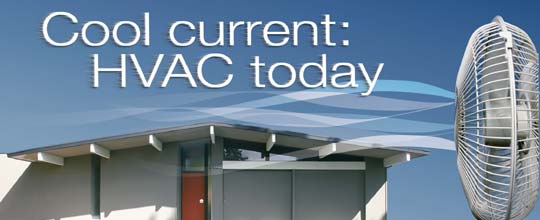
eichler home and house fan image

Traditional window-type air-conditioning units, commonly found in conventional homes, help keep heat at bay one room at a time, but these noisy, unattractive boxes can be inefficient and even invite intruders. Traditional rooftop HVAC (heating, ventilation, and air conditioning) units, with their tangle of unsightly ductwork, also clash with the streamlined, mid-century modern aesthetic. You may stay cool, but your neighbors will not thank you.

downing

On the flip side, many original Eichler radiant-heat systems, especially the steel ones, are fading out, leaving homeowners chilly in the winter. Few have the chutzpa to clear out the furnishings in their home, re-groove the concrete slab, and replace their defunct radiant system with a new one. It's a time-consuming, inconvenient, and costly proposition. This forces many homeowners on a quest for efficient supplemental and replacement heat sources. And even if a home's radiant is still kicking, it's nice to have the option to flip a switch and get a quick burst of heat when needed.

As much as half of the energy used in our homes goes to cooling and heating, so making smart decisions about upgrading HVAC systems can have a big effect on utility bills -- and comfort. Enter today's improved heating and cooling options. We've rounded up the best low-profile, streamlined systems that fit in with modern aesthetic.


LOW-PROFILE ROOFTOP SYSTEMS

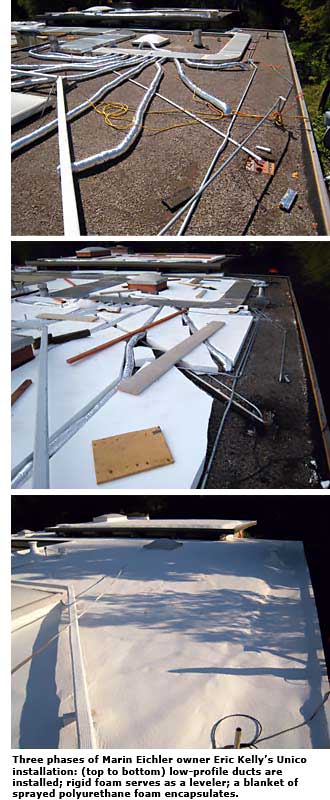
three views of roof installation

At the top of the list for aesthetically pleasing options are the elegant, yet somewhat expensive, low-profile rooftop systems. Low-profile technology has been around for 20 years, and HVAC specialists recommend it for historic homes because of its streamlined nature and capability of providing both heating and cooling.

Both the Unico and SpacePak heating and cooling systems can be retrofitted without compromising the design or architectural integrity of even flat-roof homes. Their two-inch high-velocity supply ducts fit where conventional heating and cooling ductwork can't: encased under foam roofs and slipped through existing ceilings without remodeling.

The Unico and SpacePak whole-house systems, including installation, range in price from $24,000 to $28,000 for the average flat-roof mid-century modern home, but that does not include the cost for a new foam roof, which is a necessary complement for the install. "You have to do the roof and perhaps even get the electrical upgraded when you do these systems," says Kevin Stover of Downing Heating & Air Conditioning in San Rafael.

The core of the Unico system is the air handler, which is made up of the blower housing and fan coil modules. The homeowner chooses from an air handler that cools, heats, or does both, and it is usually installed on the roof. The air handler connects to two-inch ducts that run across the roof and pop through the roof to the interior ceiling to a choice of inconspicuous outlets: the two-inch round or an eight-inch by 3/4-inch slotted diffuser. The outlets come in a variety of styles, including wood finishes, plastic, and metals that blend into any decor.

"When we have visitors come to our house, they commonly mistaken the small two-inch round registers [positioned on the ceilings] as recessed lighting," says East Bay Eichler owner Alexander Victa, who likes the subtle impact the Unico has on his interior. "We also appreciate how the house's temperature throughout remains relatively even without cold or hot spots favoring certain rooms."

Unico offers a variety of options for these systems, including a return air box, drop box, humidifier, and air filter for fresher, cleaner air. A UV light option also destroys bacteria before the air is blown throughout the home. Another option is the UniChiller, an exterior unit that creates zone cooling.

Allow three weeks for the installation of a Unico system when a new roof, and perhaps solar panels, are part of the project.

Kevin Bock, owner of AirQwest Heating & Air Conditioning, which services Palm Springs and Southern California, says he prefers the SpacePak system because it is easy to install, with connects that join parts without tools.

The SpacePak system uses sound attenuators, or short lengths of flexible, baffled tubing to help keep the system quiet. A plenum carries cool or warm air from the fan coil unit to the different ducts throughout the house. The fan coil connects to an external condenser for cooling. SpacePak also offers an optional PurePak air cleaner that captures contaminants from the air as mall as 0.3 microns with 97 percent effectiveness, the company reports.

Indoors, the vent grills are five inches in diameter (roughly the size of a compact disc) and homeowners can choose from cast iron, wood, plastic, or brass finishes. "It looks good, but it's a big project that takes two to three weeks with a new foam roof," Bock says.


MINI-SPLITS

Ductless mini-split systems are a practical and cost-effective retrofit cooling and heating option. Like conventional central air conditioners, mini-splits use an outside compressor/condenser (roughly 20 by 30 by 10 inches). The difference is that every room or zone to be cooled has its own interior air handler that is roughly 10 by 33 by seven inches in size.

lance eastman

"Each indoor unit operates independent of the other, which makes it easy to control the temperature in specific rooms and further save energy consumption," points out Lance Eastman, owner of Bay Area Plumbing & Heating, based in Redwood City.

The interior units connect to the outdoor unit through a conduit carrying the power, refrigerant, and condensate lines. The air handlers come in various sizes to cool areas up to 1,000 square feet. "The advantage of this set-up is that the conduit is no more than three inches in diameter, making it possible to install these systems in a more unobtrusive way," Eastman explains.

From the outside, the unit can be tucked along of the house or in an area of the yard where it's not noticeable. The conduit can be installed through the roof, or through exterior walls. The condensate can be drained to the outside, or as some homeowners have done, through the drain in the laundry room (for those who don't want to penetrate the roof).

Unlike window air-conditioning units, mini-splits keep a home more secure, since there are no large openings in walls or windows that invite intruders. They are also quiet. Air handlers fit snugly against the interior wall, and can be placed in between beams to be less noticeable. Some owners, says Eastman, have created cosmetic encasements to disguise the indoor units and blend them into their home's decor.

The condenser can also be located as far as 40 feet from the air-handling unit, making it easier to tuck it away on the side or back of the house. One condenser, depending on its capacity, can support as many as four air-handling units. By avoiding the use of ductwork, mini-splits also avoid energy losses associated with central forced-air systems. New mini-split systems for an average home cost around $5,000 apiece, Eastman says.

Mini-splits are manufactured by a host of companies, including Samsung, Mitsubishi, Fujitsu, Hitachi, and Friedrich. These companies have established good lines of distribution, training, and technical support.

mini split views

VALANCE

William Lipp, owner of Lipp Hydronics in Redwood City, invented his own radiant-heat system, installed on ceilings and walls, in 1974. "At the time, the baseboard heating systems [once the only radiant-heat replacement option for Eichler homes] on the jobs I went on were all looking tattered, and it was not offering the best heating for Eichlers," Lipp says.

He created the Valance system: a long, thin unit, about nine inches deep, that runs hot water through fin tubes. Usually hung along the beams in an Eichler ceiling, the tubes are concealed using a five-inch face board or wooden grill. Air enters the heating unit from the bottom, and it is heated and distributed from the top. "There are no fans or blowers, so it's very quiet and efficient like any type of radiant heating," Lipp says.

If a homeowner hangs the Valance on the wall, Lipp points out, it can be painted or wallpapered to blend into the room's décor. Lipp usually recommends at least one Valance unit per room, and a whole-house install, he says, costs between $12,000 and $30,000 with a new high-efficiency boiler. There is no cooling option available with the Valance.

"This system really fits in Eichler homes," Lipp says. "Customers say that the Valance system offers more comfortable heat than traditional radiant."


TWA

A Marin county heating firm that works on Eichlers has been exploring a new way to provide radiant heat in modern homes. Rather than excavating through the slab to replace broken pipes, Bob Reid of Reid Heating & Energy suggests installing radiant panels on the ceiling, along the beams, similar to the Valance option.

"When your radiant heat fails, there are not a lot of options," Reid says. "Some people convert to baseboard or forced-air heating, and it's not as comfortable as radiant heat. When you put radiators or baseboards along the walls, you also deal with issues such as furniture placement." Aesthetics is also a consideration.

Reid's Twa (pronounced 'twah') panels, manufactured by Twa Panel Systems, can be mounted one or two per room, attached to water pipes atop the roof. The pipes are inconspicuous, Reid says, and the boiler usually fits into a closet. Plus, with additional hardware, the system can provide cooling as well.

The panels are roughly three inches thick, and range in size from two-by-four feet to four-by-eight, though sizes can be customized since panels are made to order. Panel colors can also be custom-ordered, and include dark colors to match natural wood.

"Radiant ceiling panels have been around forever," Reid says -- but not in Eichlers. They are popular in commercial work, and work as well in residential, he says.

The panels work like the original Eichler radiant heat systems -- heating objects in the room, not the air. The system is quieter than forced air, Reid says, and much easier to install than baseboard heating.

Installation of Twa panels takes about a week in a standard Eichler. Heat versions cost between $15,000 and $24,000. "If you don't have a high-efficiency boiler, your cost goes up to as high as $30,000 total, depending on the boiler model," Reid says. To add cooling to the same system, he suggests tacking on an additional $12,000.

"The beauty of the Twa system is that it gets people back into radiant heat," Reid says.


APPEALING FINANCIAL INCENTIVES

Paying for a new air-conditioning or supplemental heating system can put a major crimp in finances. Thankfully, the Federal government and local utility companies are offering a number of tax credits and product rebates to encourage homeowners to install more energy-efficient heating and air conditioning.

Homeowners can claim 30 percent of the costs (up to a $1,500 limit) for the installation of higher efficiency cooling and heating equipment for the 2009 and 2010 tax years. The tax credit applies to the installed costs of the qualified equipment, which includes labor.

"The $1,500 limit applies to many types of energy-efficient home improvements, including windows and doors, roofing shingles, and insulation," Downing's Kevin Stover says. Homeowners may only claim $1,500 in total for any improvements and can choose to use the entire credit toward the installation of one appliance.

Local utility companies, including City of Palo Alto Utilities, are also offering rebates on qualified products, and in particular those with the Energy Star designation.


Homeowner's journal: on an HVAC journey

eric kelly

Eric Kelly embarked on an ambitious project for his family's 1960 Terra Linda Eichler in spring 2007: a new foam roof, a Unico HVAC system, an upgraded electrical panel and wiring, and a 3.4 KWh photovoltaic solar system.

"The radiant heat failed back in the 1980s and was then replaced with an inadequate forced-air system, which only heated half the house," Kelly recalls. "The other half we heated with electrical space heaters, which guzzled electricity and never really did a good job."

Kelly's tar-and-gravel roof was in reasonably good shape, but provided no insulation, making the house an oven on hot summer days. He decided to do these projects all at once since they all involved changes to the roof.

For budget reasons, Kelly originally planned to install a traditional HVAC system on the roof. "However, we quickly discovered a San Rafael building ordinance [protecting the streetscape aesthetics of the Terra Linda Eichler neighborhood] forbidding the placement of anything on the roof rising more than six inches above the surface without a review process before the planning commission."

Kelly settled on the Unico system in conjunction with a foam roof because, he says, he didn't like the look or the complexity of the mini-split option. According to Kelly, the Unico cost $28,800, the new foam roof $25,200.

"The combined cost of the Unico and the roof was particularly jaw-dropping for us," Kelly says. "Had we been able to install a 'normal' HVAC system on the roof and didn't need the special Unico roof kit, the combined costs would have been almost $17,000 less. So this is the premium you pay for a Unico system."

After installation, Kelly noticed that the house was cooler in the summer and had better heat retention in the winter, thanks to the new foam roof. "We probably only ran the AC a total of 14 to 20 days during the summer," Kelly says.

On average, Kelly's PG&E (electric and gas) bill prior to the Unico and solar installations was approximately $281 per month; in the past year they averaged $174 per month.


Photos: David Toerge, Eric Kelly


RESOURCES

AirQwest Heating & Air Conditioning: airqwestac.com
Bay Area Plumbing & Heating: baph.com
Downing Heating & Air Conditioning: downinghvac.com
Lipp Hydronics: 650-327-1943
Reid Heating & Energy: reidheatingandenergy.com
SpacePak: spacepak.com
Twa Panels: twapanels.ca/heating.html
Unico System: unicosystem.com


When it's time for your next home-improvement project, consider
the Eichler Network's team of 'Preferred Service Companies.'


dura-foam solar center
eichler solutions

Top of Page


pixel

The Eichler Network
info@eichlernetwork.com