


Artistry of an Eichler Home
 |
|
|
Just for an experiment, pretend that your Eichler home is not a house at all but a work of art, something to be experienced aesthetically, as something you are seeing anew, no matter how many years you have lived there.
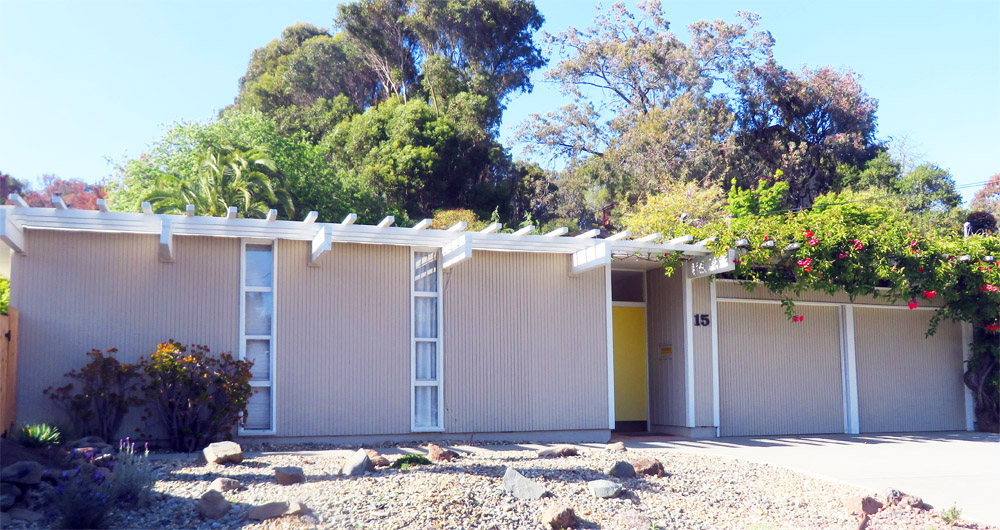
That's how artist Alan Sonneman sees the Eichler in which he lives and works, in the Palo Alto development of Green Gables.
"It's amazing, living in a real masterpiece," he says of the compact home from 1950. While Sonneman loves the home's functionality, it is the artistic thought provided by Joe Eichler's original architects, Bob Anshen and Steve Allen, that really makes it special.
 |
|
|
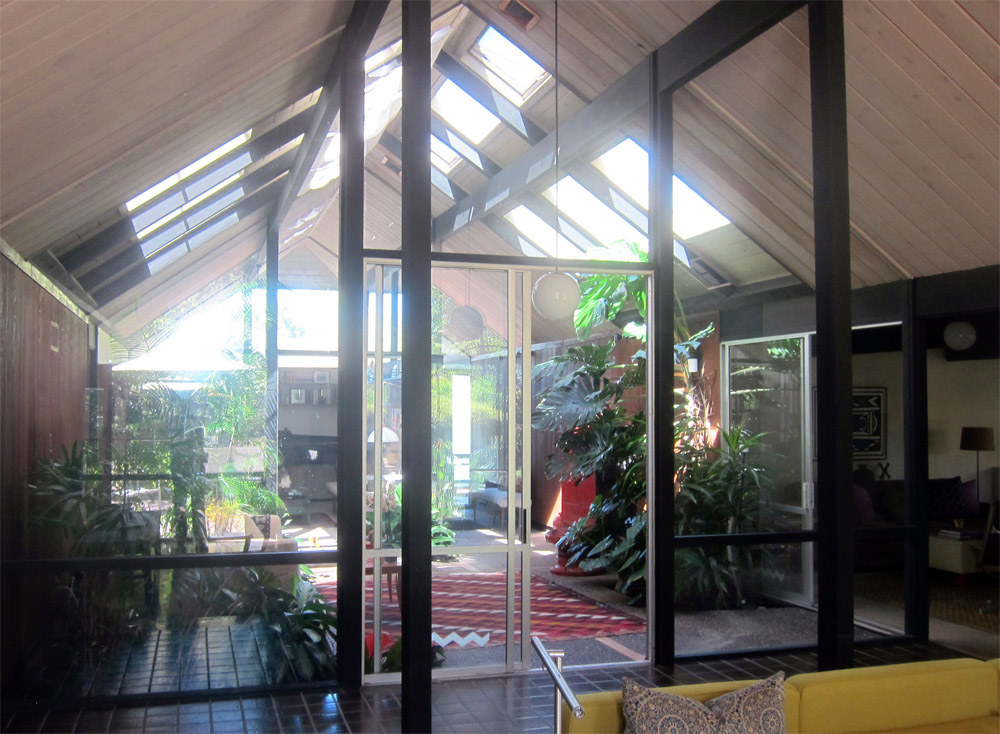
Sonneman, with his artist's eye, appreciates the unusual sightlines produced throughout the house by its geometric planning, the textures, and the light. Anshen and Allen were influenced by Frank Lloyd Wright, and Sonneman sees the connection. He is sure that the two architects, who were educated in Pennsylvania, spent time in Wright's masterpiece, Fallingwater, which is also in that state.
Sonneman compares his house to a school of art that grew up in Soviet Russia just as the Revolution was transforming that land more than a century ago, a radical style that stripped form to essentials and featured dynamic, off-kilter compositions.
"This house functions as a very Constructivist house," he says. "I'm a real fan of Russian Constructivism." In his Eichler, he says, as in an abstract composition, planes and lines play off each other in dramatic ways.
 |
|
|
Modernism in architecture, which also began just over a century ago, generally rejected applied decorative or historical elements, like Ionic columns, in favor of form, texture, and color to provide artistic substance to a building, with all aesthetic elements growing out of the building's function and structure.
Some modern architects explicitly linked their home designs to abstract paintings. Landscape architect Robert Royston, who did designs both for Eichler tracts and individual Eichler homes, was among several California landscape architects whose designs are, in effect, abstract art on the land.
That's why to appreciate the artistry of an Eichler requires experiencing, seeing, feeling, and moving through the structure as a whole, to appreciate relations of line, space, planes, and light.
- Login to post comments
Search