


Going Beyond the Bauhaus
 |
|
|
Student architects seek inspiration from many sources: venerable architects like Vitruvius and Palladio, the functionalism of the Bauhaus, science and mathematics, natural forms.
How about fairy tales?
At the University of Oklahoma's School of Architecture, fairy tale imagery did indeed inspire the students, under the tutelage of Dean Bruce Goff, who was department chair there from 1947 to 1955.
Mickey Muennig, a student of Goff's who went on to become a master Big Sur architect, recalled displays at the university of ornate, delicate fairy tale illustrations of the early 20th century by Kay Nielsen and Edmund Dulac.
 |
|
|
The sort of architecture that developed at this campus in Stillwater, Oklahoma, was latter dubbed 'the American School' by one of its practitioners, Donald MacDonald (best known in the Bay Area for his expressive design work for the Bay Bridge's eastern span.
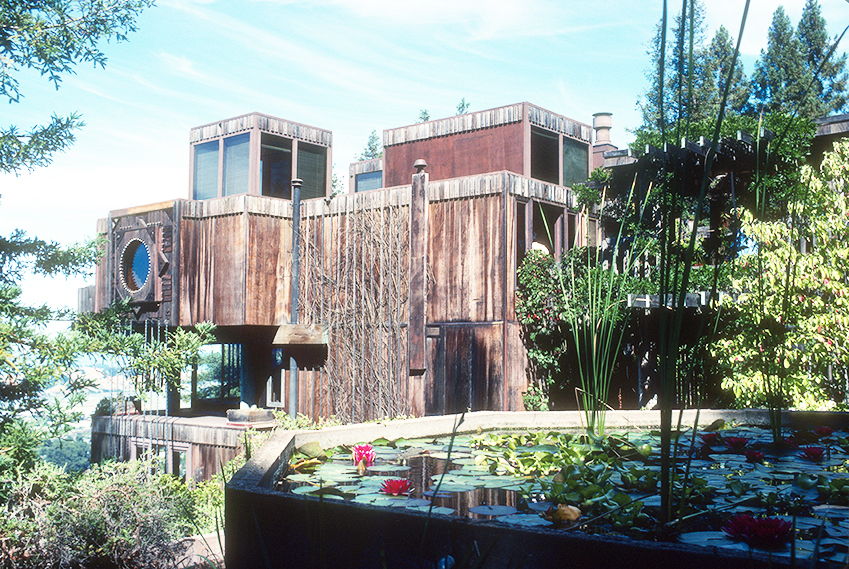
An evocative exhibit at the American Institute of Architect's Center for Architecture + Design in San Francisco, 'Do Not Try to Remember: The American School of Architecture in the Bay Area,' focuses on architects whose work can be seen in Kentfield, Big Sur, Stinson Beach, Sausalito, Monterey, and other locations.
'Do not try to remember' was their only dogma, the curators say. "Do not burden yourself with the past. Do not attempt to copy. Invent!"
The architects shown in the exhibit, all of whom studied in Oklahoma, have been called "iconoclasts, radicals, and even outlaws," the curators write. The architects rejected "Bauhaus-inflected traditions," with their "functional, machine aesthetic," in favor of "historical precedent, like traditional Japanese wood joinery, and…the local vernaculars, like Bernard Maybeck's iconic arts-and-crafts."
 |
|
|
Although none of Joe Eichler's architects were part of the American School, they too were influenced by Frank Lloyd Wright and by Japanese and vernacular and Arts and Crafts traditions. Some of Eichler's architects, and in particular Bob Anshen and Steve Allen, explicitly rejected what they saw as the rigidities of Bauhaus-influenced modernity.
Their alignment with this more expressive way of building can be seen in Eichler homes' use of warm textures and natural materials, and in the homes' dramatic layouts, with their atriums and galleries.
Anshen and Allen's true fairy tale buildings, though, include some of their non-Eichler work, such as their Chapel of the Holy Cross in Sedona, Arizona, and Central Methodist Episcopal Church in Stockton, California.
 |
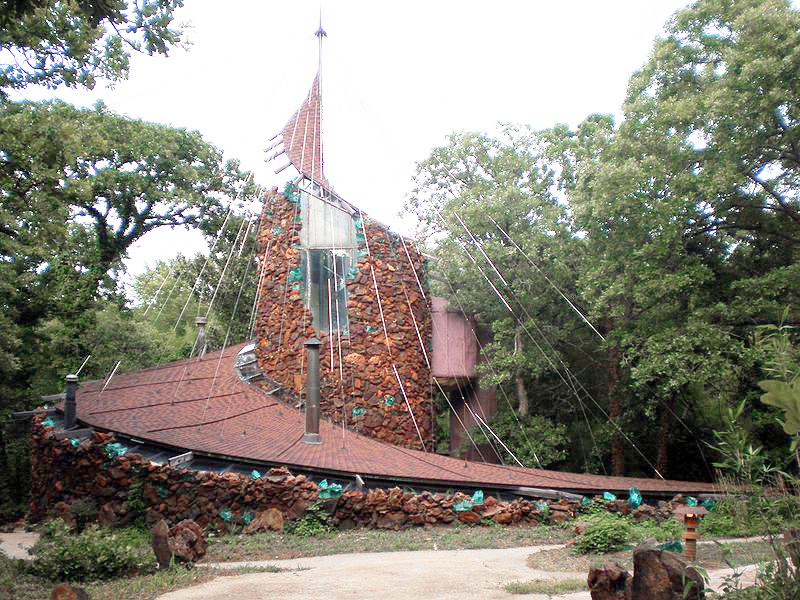
Bruce Goff's spiral-shaped Bavenger house in Norman, Oklahoma, which suggests both a sailing ship and a living form, was published in Life magazine in 1955, attracting many imaginative students to study with Goff in Oklahoma.
Among members of the American School there is much variety of work, although free forms, curves, and natural materials are common—as are projects that are built by the architects themselves and/or by their clients.
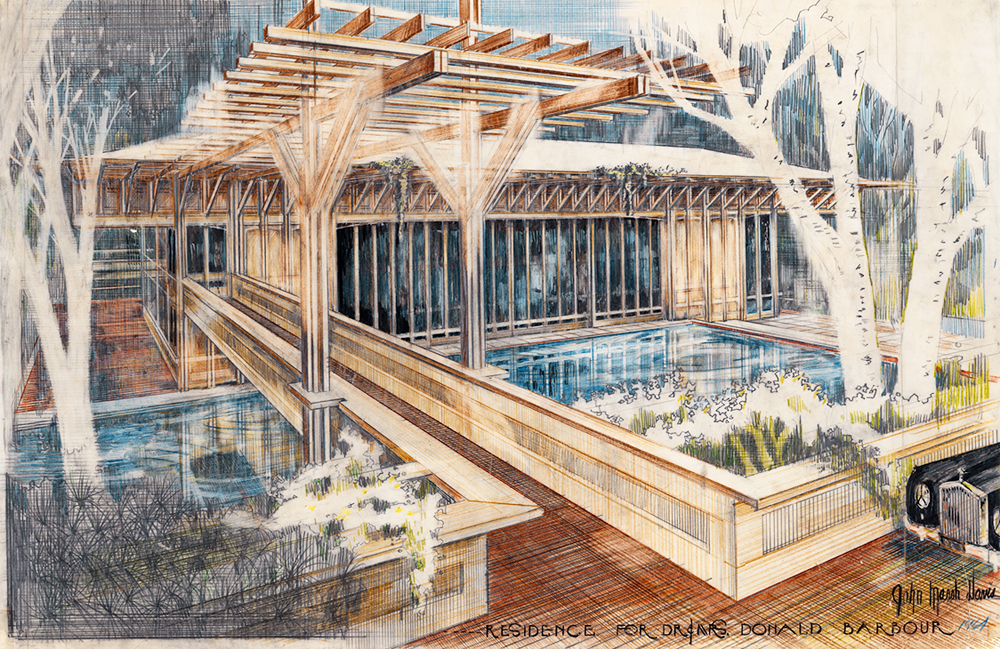
Among the works shown in the exhibit, through copies of photos, plans, drawings, and elevations, is architect John Marsh Davis's 1965 Barbour residence in Kentfield, with a "living room [that] opens to the outdoors through an enormous sliding glass and wood door."
Search