


Whimsy in Wood - Page 4
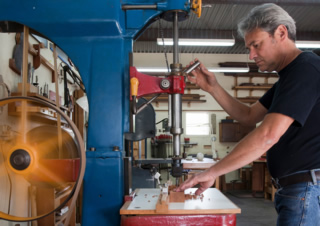
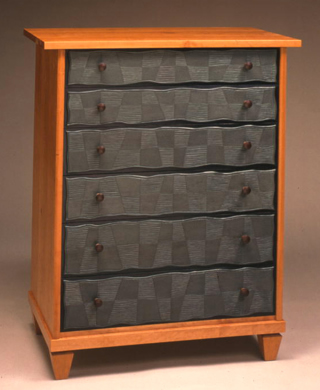
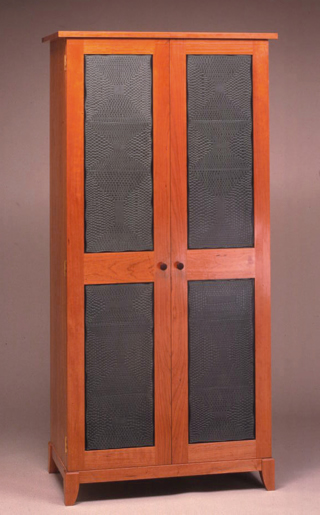
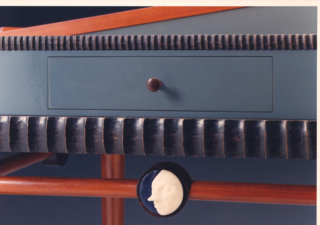
"I've always liked the idea of pattern," Cullen says. "My feeling with furniture a lot of time is it's so static. The patterns, depending on the way they're carved, give a dynamic feel to the furniture because they change with the light and the shadow. That's always been a big part of my work, shadow."
Cullen's interest in movement comes out in another product as well—his tops. He can churn them out quickly, particularly as the holidays approach.
"You just have to be good at lathe," he says, while setting one to spinning on a studio workbench. "I can buzz those out. By the time that one has stopped spinning I'll already have made another one."
Today, Cullen's got time to play with tops, and to mountain bike. He and his wife, Barbara, a craftsperson and art therapist, share a home near Petaluma's downtown, an almost picture-perfect, all-American kind of place, with Victorian storefronts and 19th and early 20th century villas, cottages, and bungalows. His studio is a few miles away, bordering a small barn.
Cullen has collectors in New York, New Zealand, Chicago, and Germany, and shows his work in Johnson's gallery in Easthampton, and in numerous museums and craft exhibits. About half his work is on commission, the rest done on speculation. He makes between 20 and 40 pieces a year, not counting tops, depending on the complexity of each piece.
 |
Some clients own many of his works. "Those are the clients I like," he deadpans.
"I've done a lot of work for normal people, too—teachers, postal workers. I don't want it to be just for rich people."
Clients come to his studio to choose materials, many of them locally sourced. He presents them with hand drawings and models of his proposed furniture, and usually builds life-sized plywood mockups. Many clients become friends. But at the conclusion of one job, one told him, "Next time, use the service entrance."
"We didn't do any work there after that."
Among his better clients are Kathy and Richard Jaraczewski, who have more than a dozen of his pieces in their Santa Rosa home. The Jaraczewskis commissioned Cullen to do a series of small tables for an art-filled hallway, and didn't give him an easy time about it, Kathy recalls.
"Nah, it's not good enough," she recalls Richard saying on seeing a preliminary model. She adds, "Richard can be pretty harsh, I would say." But Cullen took it in stride and returned with a proposal that pleased. "The quality that Michael produces is just stunning," Kathy says. "Every aspect of the piece is finished."
 |
 |
|
|
|
 |
|
|
Cullen has supported himself as a woodworker since studying with Powell at his Leeds Design Workshop in Massachusetts, selling his first table for about $400.
Times were tight, for a while, and for years Cullen worked in cooperatives and otherwise shared space. "It was a long battle. And still today, you take your foot off the accelerator and the car stops. You always have to be on your game."
"I just love to make things," he says. "The idea that I can actually come into the shop in the morning and make something and somebody will buy it, I think that's amazing."
It was just over a decade ago that his business, as opposed to his work, jumped a notch. Friends, astounded when he revealed what he was about to ask for a hall table, said, "You're out of your mind. You need to double your price."
He did, and the gallery owner who was planning to sell it blanched. "The first thing out of their mouth was, 'But that's as much as so-and-so charges.' I looked the owner right in the face—it was a good lesson—and I just said, 'Yeah that's right, because it's better.'"
Today he's even thinking of raising the price of his tops.
- Login to post comments
Search