



Neighbors Seek to Reconnect
 |
When the Fairgrove Eichler tract in Cupertino was new, 'block parties' played a big role tying the community together.
"Everybody in the neighborhood would come," says Nancy Burnett, who with her husband bought their home here from Eichler Homes even before it was built.
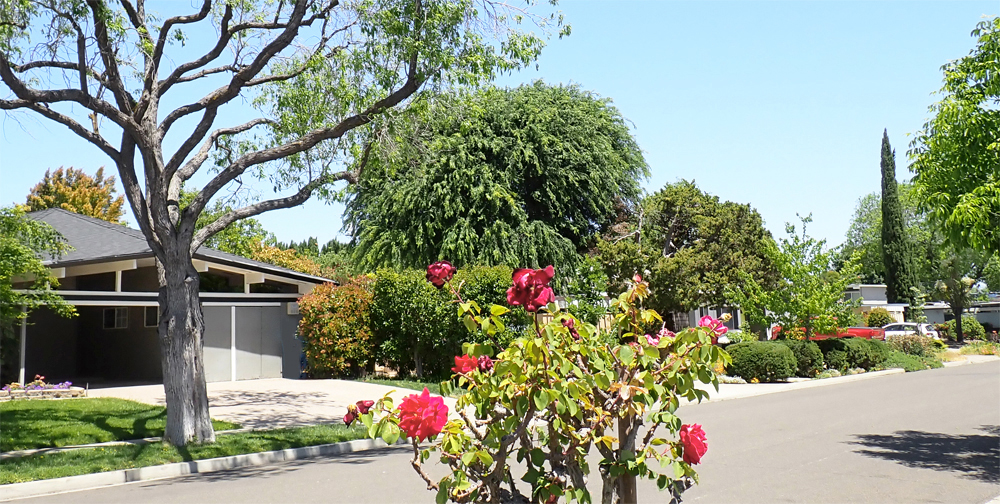
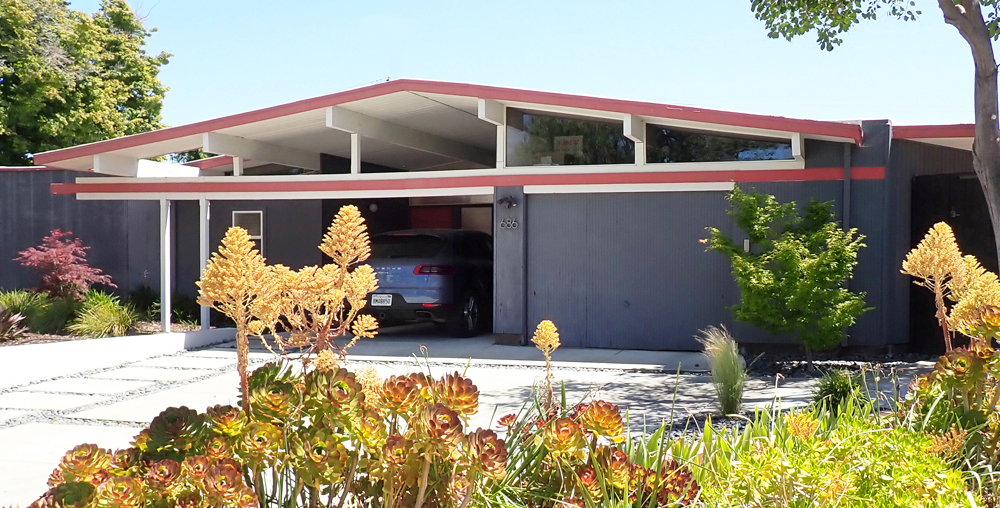
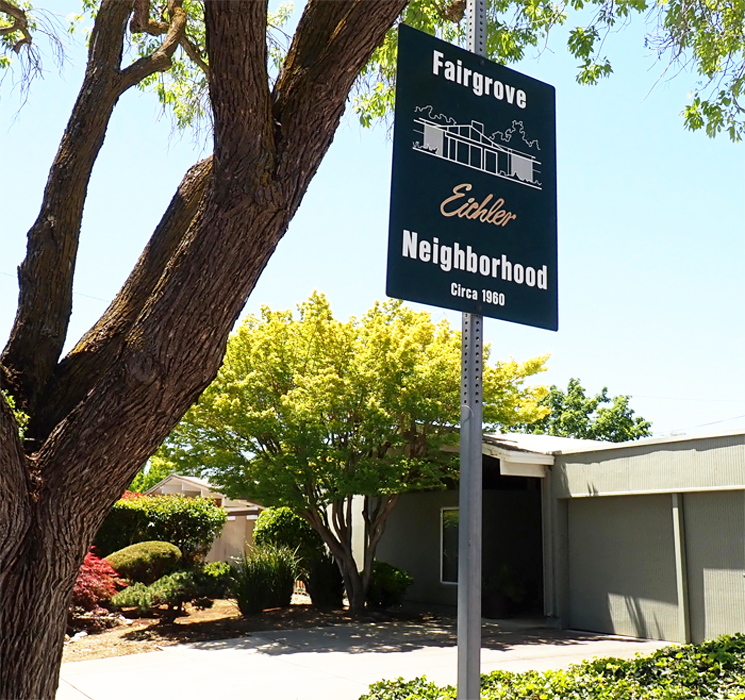
Joe Eichler's lone subdivision in this now‐sprawling South Bay city, the 230‐home development, built in 1960 and 1961, still retains much of its looks, but little of the communal feeling that was felt in earlier days.
 |
But a handful of mostly newcomers are trying to change that. Resident Carol Maa is leading the charge, hoping to model Fairgrove on another Eichler neighborhood, Greenmeadow in Palo Alto, where homeowners know each other, get together regularly, and work to preserve their homes' architectural values.
How does Carol, who is raising two young children in Fairgrove with her husband, envision the neighborhood in the future?
 |
She sees a place where "everybody just goes into each other's houses, and block the street and play in the street," she says, describing of facet of traditional block party festivities. "That, for me, is just the quintessential kind of American, Californian childhood."
"I'd like to see more cohesion," she adds, "because right now there's a lot of, like, seniors who don't leave their houses, and they're literally housebound, and they don't connect."
Carol, who moved to Fairgrove during the early months of the Covid pandemic, was brought into the communitarian fold shortly after arrival by none other than her next‐door neighbor, Nancy Burnett, who had never forgotten the days when Fairgrove buzzed with social activity.
 |
"We had a little newsletter, and we had get‐togethers, and annual [larger] get‐togethers," Nancy recalls. "We would block off a section of the street so that the traffic could not come through."
For years Nancy, a former teacher with a focus on textiles, clothing, and home economics, served as one of the neighborhood's block leaders, a function that has fallen away, especially since the pandemic.
"The first month we moved in," Carol says, "[Nancy] came by with her walker and said, 'I'm the neighborhood block leader. And would you like to be on the [neighborhood] list?' And I was like, yes !"
 |
Soon, Carol says, she was getting to know as many neighbors on her street, Stendhal Lane, as she could, and "checking on older neighbors in this community."
Until recently, the neighborhood had a phone tree connecting people, but that died around 2017, she says.
Carol also created and began passing out a flyer throughout Fairgrove: 'Let's Get Reconnected.'
 |
"I created a flyer with a QR code so that people can find and join our email list. I've been sharing with some of our neighbors so that at least they could share it with their friends in this neighborhood. But it's a little bit difficult," she says, noting that many neighbors are private and do not want to get involved.
It may take time to build community, she says. She has put together a list of neighbors for get‐togethers, but it is small. She says that any homeowners group that ever existed is long gone, the covenants and restrictions that came with the tract to protect homes are not enforced, and the city of Cupertino is not doing an adequate job of enforcing the city 'Eichler Design Guidelines' that were adopted in 2001.
She says that many newcomers are doing great things to their homes in keeping with the Eichler style—though others are not. She and a few other neighbors are upset with a recent remodel that is replacing an original‐looking Eichler with something some believe violates the guidelines.
 |
Another neighbor hoping to build a sense of community is Chris Tisdell, who with his daughter, Violet, created and keep stocked an 'Eichler Museum,' a 'Little Free Library' sort of structure filled with art to encourage people to stop, look, and chat. "Here we have the chance to actually bring a little bit more engagement to the community," he says.
"The goal is that over time, we can start highlighting other people's artwork from this neighborhood," says Chris, who trained as an architect and now works for a firm that builds modern modular homes.
Chris and his family often sit in front of their Eichler in chairs set up to provide a view of the street, chatting to dog walkers and others who stroll by. "I thought, this is a great area just to be able to see people walking by, connecting with people," he says.
 |
Ultimately Carol would like to see a stronger community lead to stronger protections for the homes.
"The new owners who have moved in, some are really obsessed with Eichlers." But some just do not care, she adds.
"What I would love is that we become a much more passionate community," Carol says, "and really become advocates to City Council and Planning about how this neighborhood needs to be preserved."
• Fairgrove neighbors looking for more information can connect with Carol Maa via e-mail at [email protected].
- ‹ previous
- 444 of 693
- next ›
Search