

Reading Rooms for Modernists
 |
|
|
Sometimes a longtime public servant needs a little appreciation, a little love.
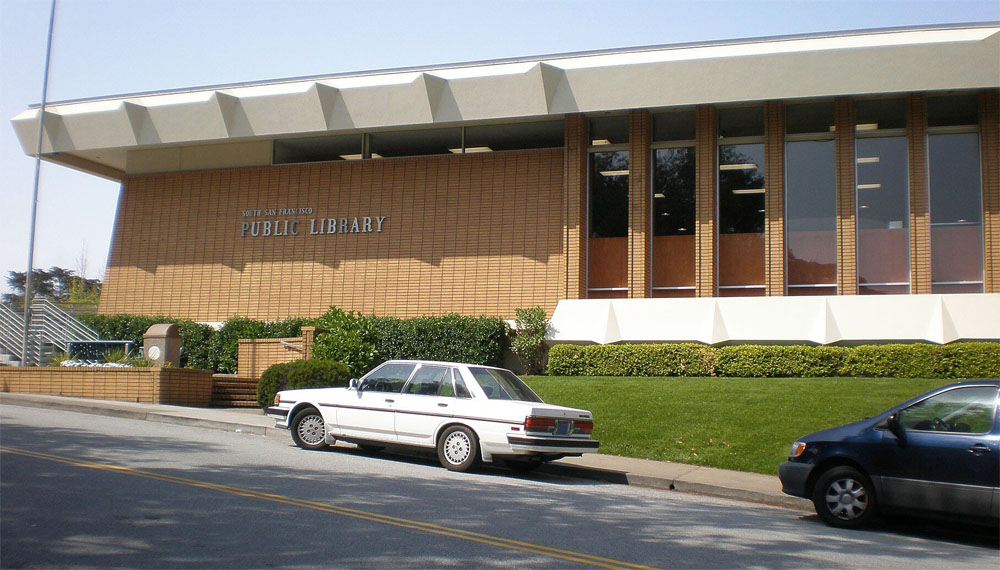
Cheryl Grantana Rich, who began working at the South San Francisco Public Library on West Orange Avenue in 1969, three years after its opening, feels that way about her former workplace, which served the people of this Peninsula town since 1958 and is today facing a transition.
"It was my whole career," says Cheryl, who lived nearby in a Foster City Eichler and retired after 45 years as assistant library director. "I was a kid when I started. I hadn't even been to library school yet."
 |
|
|
Valerie Sommer, today's library director, shares Cheryl's enthusiasm, which, she says, represents the opinion of most library patrons.
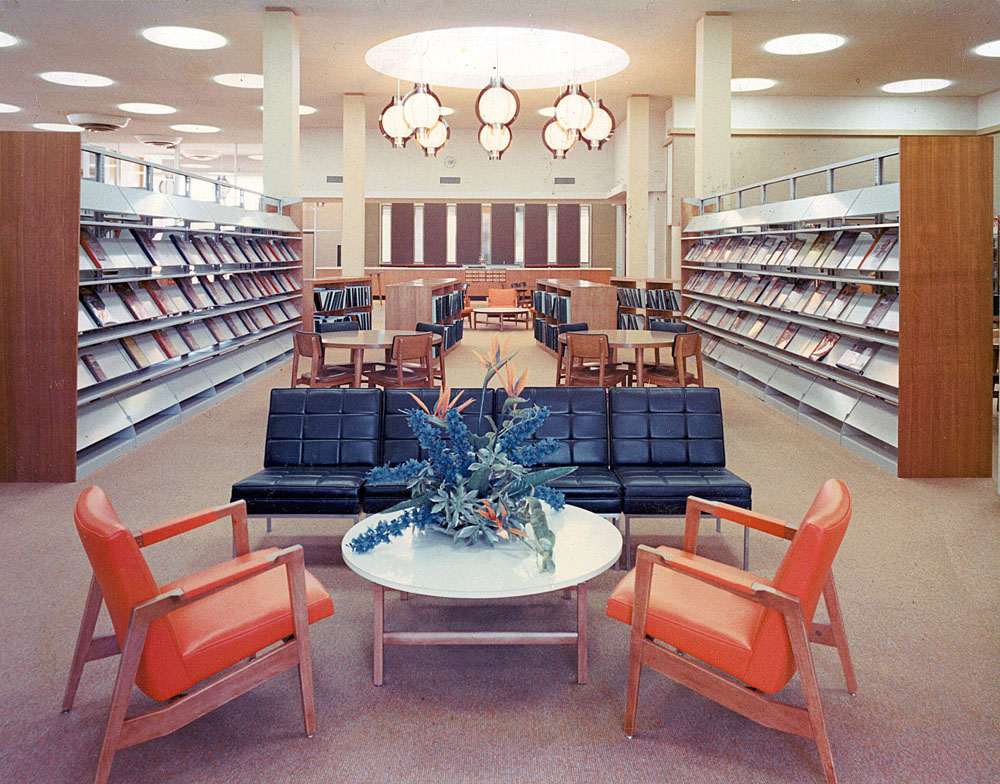
"It's a beautiful building. People love it," Valerie says of the building, which was designed by the architectural firm Markling and Yamasaki. "It's a comfortable building, and everything is on one floor. There were nice seating areas and plenty of books. The high ceiling makes it feel very spacious."
Starting in the 1930s—with roots going back a few decades—the idea of what a library is began to change—as did ideas of what a home should be. The modernism that most owners of houses built by Joe Eichler appreciate in their homes can also be appreciated in mid-century modern buildings of all sorts.
 |
|
|
The libraries in our communities, generally easier to visit than churches or commercial buildings or schools, really show off how the same principles used by Eichler's architects—openness, the blend of indoors and outdoors, simplicity, and smooth style—can be appreciated in a public setting.
As Danish sociologist and historian of libraries, Nan Dahlkid wrote in 2011, after World War II "there was a movement toward library environments that were 'light, spacious, and informal.' Library space became even more open and transparent, with glass walls and minimalistic interior design."
 |
|
|
Dahlkid traced the roots of the modern library to such projects as Alvar Aalto's library in Vibord, Finland, from 1935; and Denmark's Nyborg Public Library of 1939, whose "unpretentious and modest red-brick buildings in a garden setting, with canals, lawns, and groups of trees…became an example of a new type of library architecture, where easy access, freedom of movement, spacious rooms, and the use of light wooden furniture were expressions of democratization and public enlightenment."
In the United States, a number of well-known modernists designed libraries, including the Bauhaus architect Marcel Breuer, who gave Grosse Point, Michigan, a red-bricked library in 1953; Frank Lloyd Wright, who included a library branch in the Marin County Civic Center in 1960; and Louis Kahn, who designed the Hewlett Building, with its Graduate Theological Library, in Berkeley in 1972.
 |
|
|
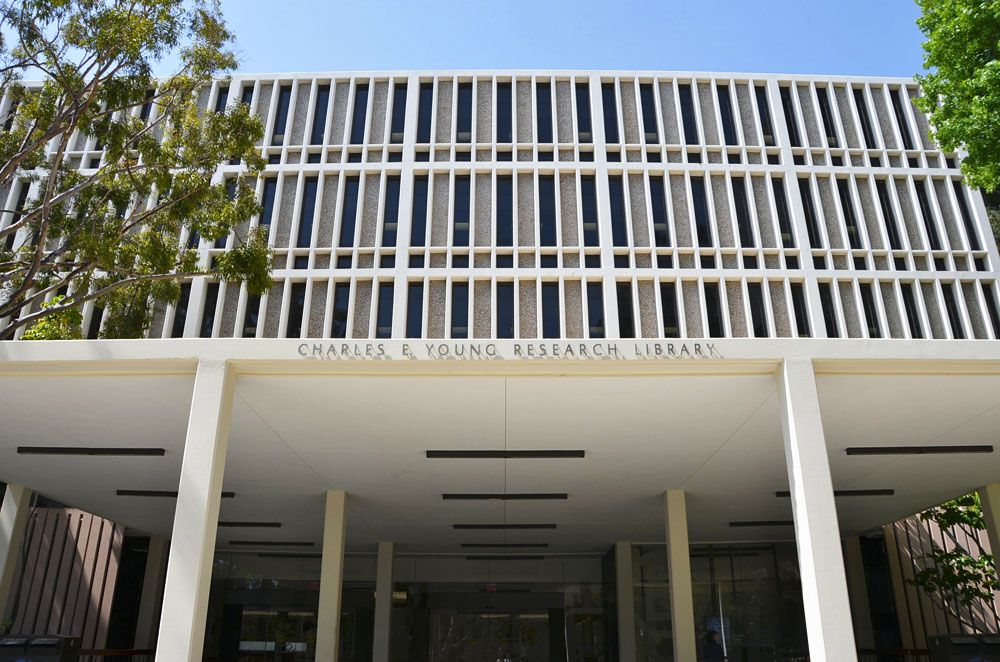
Eichler himself never built a library, but the firm of Jones & Emmons, who designed so many Eichler homes, did: the Charles E. Young Research Library at UCLA. If you visit, make an appointment at the archive there to peruse the A. Quincy Jones collection.
Throughout the Bay Area and beyond are beautiful examples of intact, or mostly intact, mid-century modern libraries.
 |
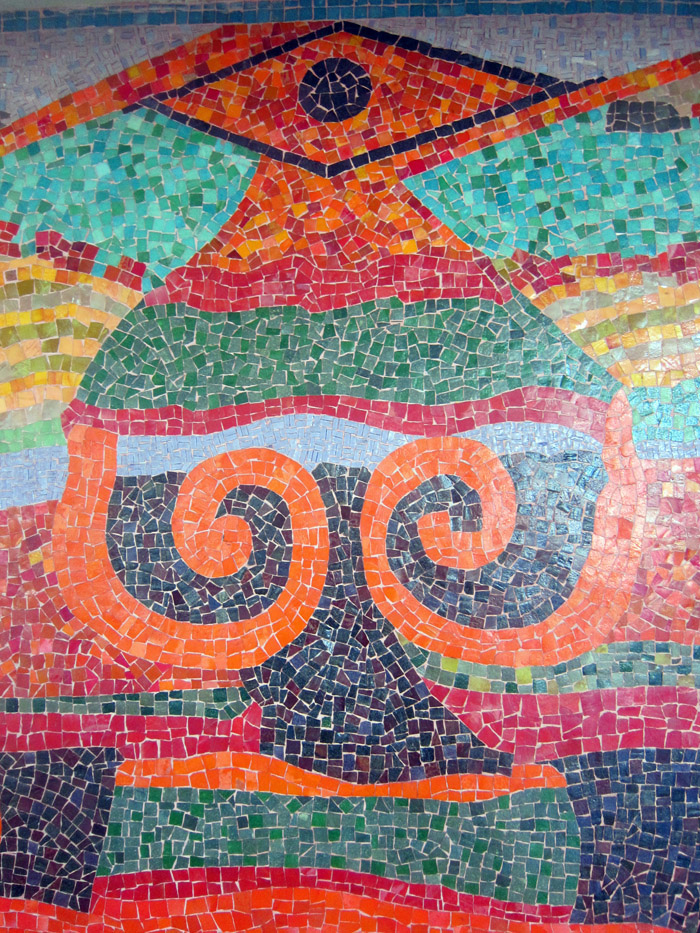
Both Modesto and Stockton have impressive, classically inspired modernist temples to literature. Stockton's, like so many other modern libraries, is enlivened with art, some of it integral to the building. Stockton's decor includes mosaic murals by artist Jean Varda.
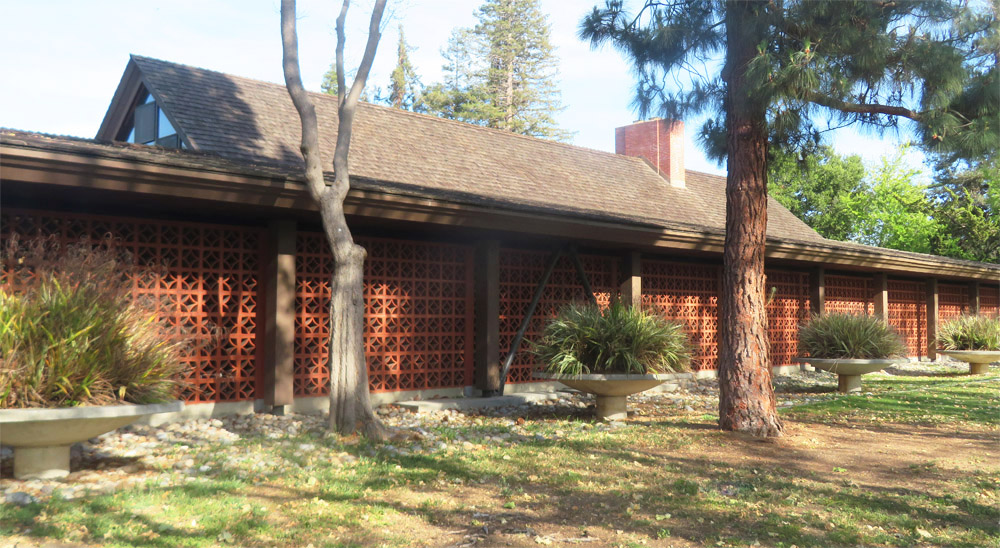
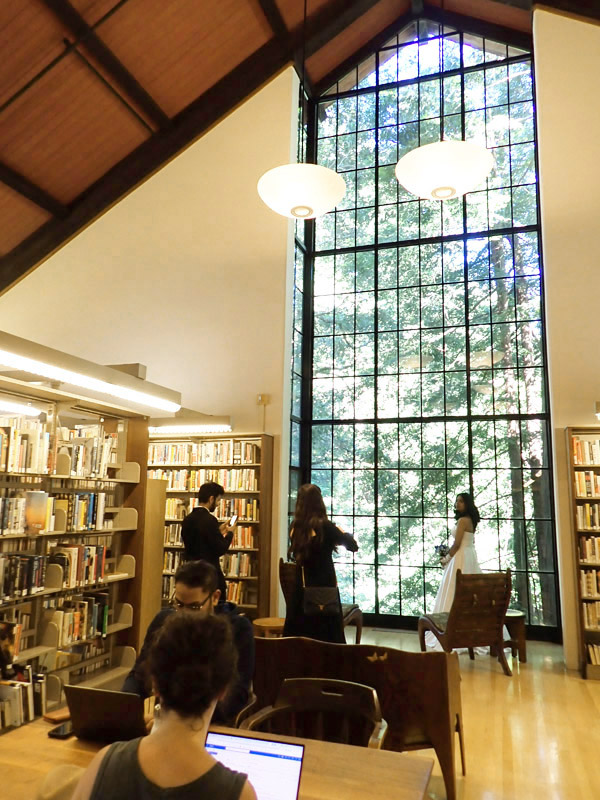
Another variant of modernism found in Northern California libraries blends vernacular architecture and the woodsy Bay Area Tradition. Ernest Kump's library in Los Altos is one such. The rustic Mill Valley library shows a touch of Berkeley Craftsman architect Bernard Maybeck.
 |
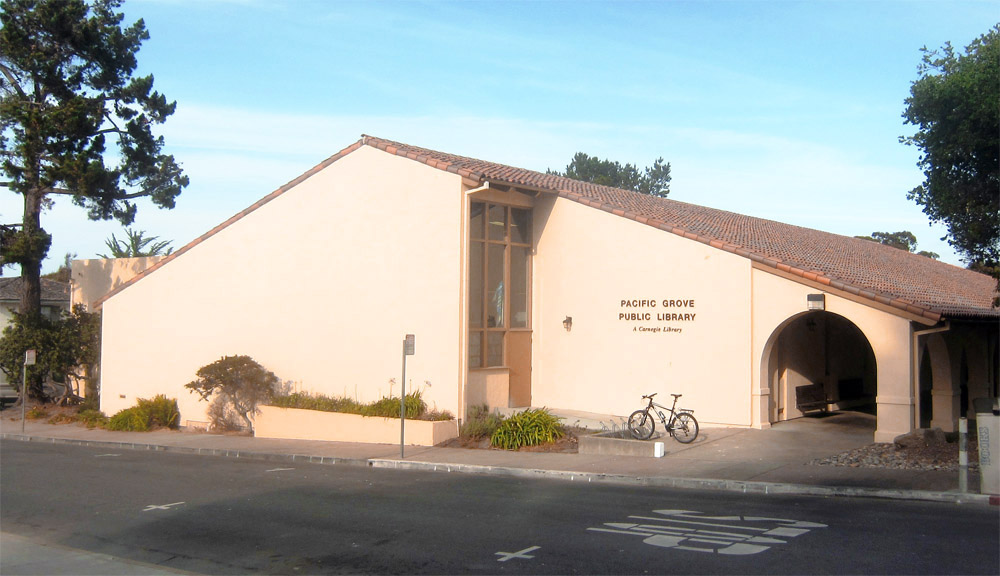
And in Pacific Grove's library, with its tiled roof, arches, and arcades, one may detect a whiff of a California Mission. Pinole's compact library, by Ostwald and Kelly, with a low pyramidal roof, has lovely mosaic murals by Emmy Lou Packard.
Among the best local modern libraries are two in Palo Alto. Both libraries—the Downtown Library, half hidden on its garden behind stucco walls that feel Spanish Colonial; and the glass-walled Rinconada Library, behind a wall of decorative concrete breezeblocks—seem removed from the rest of the world.
Both Palo Alto libraries are fully integrated with gardens that occupy both ends of each building. The Rinconada branch even has additional atrium-like courtyards. The downtown branch, from 1971, was designed by William Busse; the Rinconada, from 1958, by Edward Durrell Stone.
 |
Much as people loved the West Orange library in South San Francisco, which served for its career as the town's main library, it closed in 2023. The auditorium was too small for events, director Valerie Sommer says. The building was not seismically sound, it was hard to wire for computers, and the minuscule elevator was not accessible for the disabled.
The local Boys and Girls Clubs will move into the West Orange site for a few years while the city seeks a permanent tenant.
Cheryl Grantana Rich does not regret the change in use. But, she says, "It is an interesting building. I'd feel bad if it disappeared."
- ‹ previous
- 496 of 693
- next ›
Search