

‘Sun Villa’ Classic Hits Market
 |
|
|
How'd you like to make your next home a mid-century classic with a colorful backstory immersed in California architectural history—in fact, a rare, early design by distinguished Eichler architect A. Quincy Jones?
Then consider this: One of Jones' celebrated Southern California 'Sun Villa' originals is now up for sale.
One of only a handful of Sun Villas constructed in Los Angeles, the unique home, built in 1950, was inspired by a full-scale Sun Villa replica that was introduced and displayed a year earlier at the 'First Annual San Diego National Home Show.' There, visitors reportedly lined up with anticipation to get a peek inside the unusual, 'ultra-modern' concept home.
The home also won an AIA First Honor Award, and was published in Architectural Forum and House Beautiful magazines, ultimately leading to Jones designing a series of low-cost postwar homes that were marketed as the Sun Villa.
 |
|
|
As with Eichler homes, these modern tract houses helped elevate California tract housing from their stucco-box roots to new, modern homes that were fully integrated into the landscape.
The Sun Villa now for sale is the Webber House, which was commissioned by schoolteacher Frank Webber and his wife, Mary. Located in Glendale, just north of downtown Los Angeles, the home was modeled after the San Diego prototype.
Listed at $1.499mil by Elias Tabache of Coldwell Banker Realty, the two-bedroom, two-bath home is located at 268 West Kenneth Road in Glendale's Verdugo Viejo neighborhood.
 |
|
|
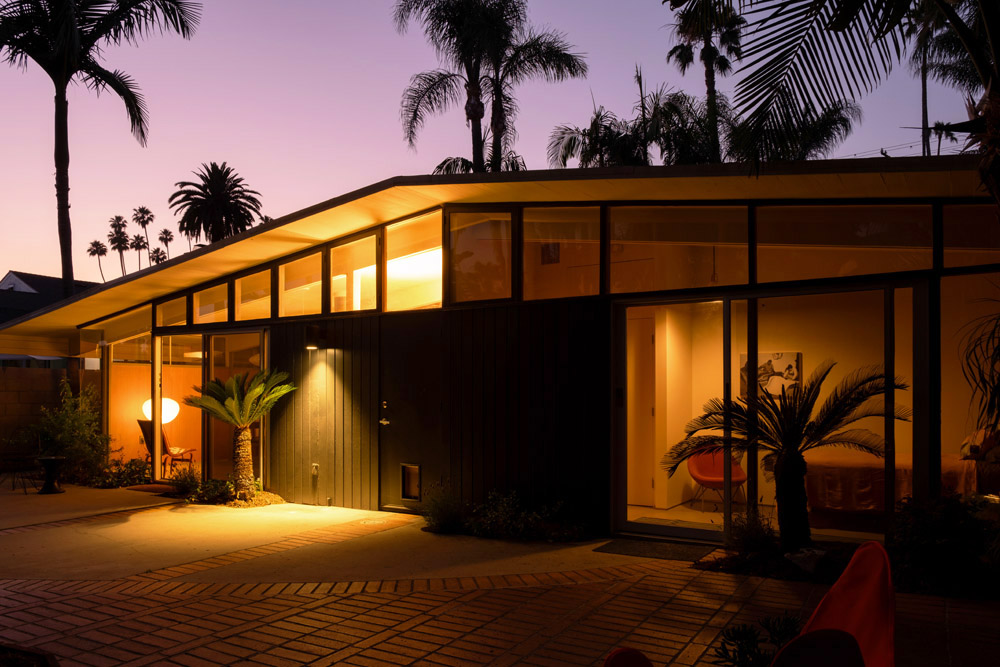
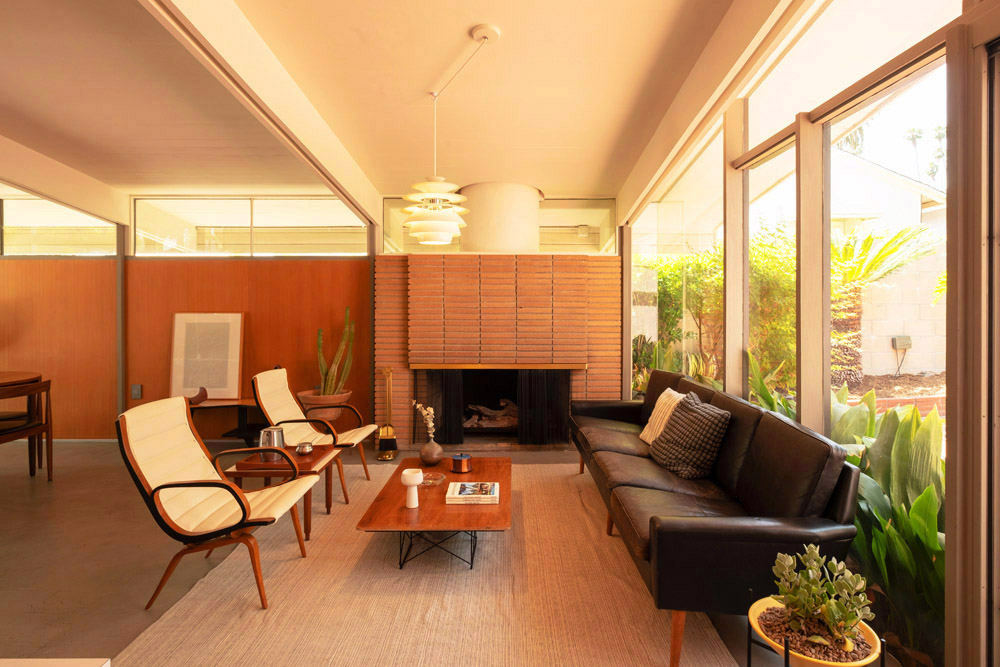
The wood-and-glass structure features deep eaves, expansive windows, and direct access to the outdoors from every room. Though compact in size, Jones' progressive open-plan design belies its modest 1,103 square feet.
“This house lives large because of all the glass," says Tabache. "Every room has a slider that leads you to an outdoor space. I have to say that the indoor/outdoor living aspect in this house is pretty incredible, how everything is positioned."
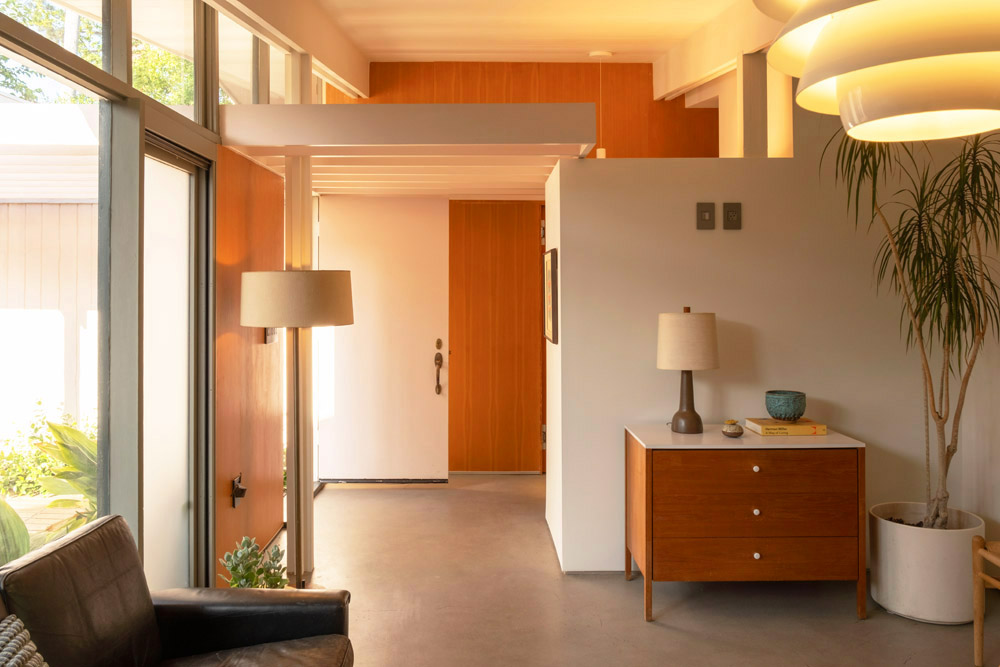
"You see the round chimney and a wall of glass, fully seeing inside the house," he adds. "And as you step inside there's a moment of question, and then it opens to the ceiling, full scale of what A. Quincy Jones was trying to design."
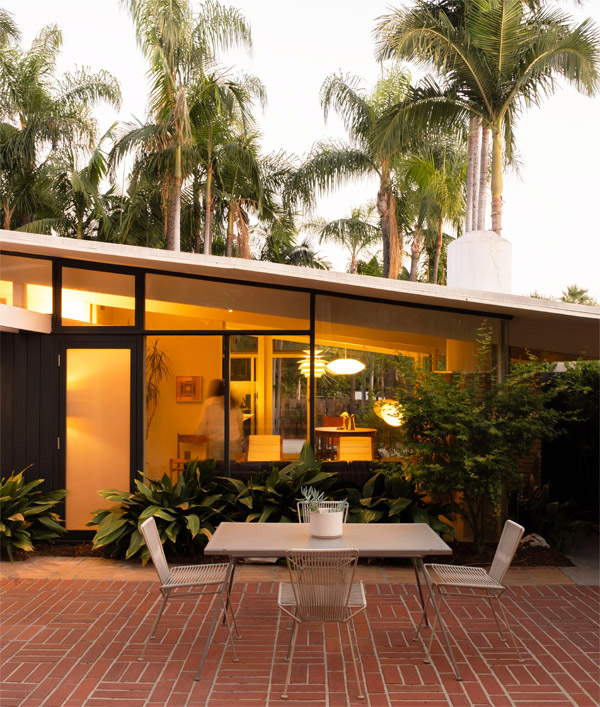 |
Anchored by concrete and cork floors, the Webber House is accented by natural light that streams through the clerestories and transparent sliders. "There's a warmth, a natural light, and an openness of being able to see the house from one side to the other, to see from the front courtyard directly through to the backyard, and vice versa," says Tabache.
Custom wood paneling defines the decidedly mid-century kitchen, which has been updated with a professional Bertazzoni range. Moving through the modernist home, you'll find two bedrooms, a dedicated office, plus one full and one half-bath.
Glass sliding doors lead out to a tropical oasis dotted with mature palms planted by the Greene family, who bought the home in 1953. A beautiful swimming pool and patios suggest relaxing California afternoons and evenings under the stars.
Search