

Eichlers with ‘Attitude’ - Page 2
 |
|
|
Their collection of glassware on the bar and an abstract painting suggestive of Hans Hofmann complete the picture.
For many people, going artistic with their Eichlers means a turn to the less is more aesthetic, which generally goes against the original Eichler look of contrasting textures, and darkness against light. While the minimalist trend can go too far, with deadly, dull, white-on-white color schemes, with care it can work.
In Burlingame some years back, we visited the home of Andrew Wolf, whose atrium artfully blended in with the rest of the interior with a stripped-down color scheme of grays and blacks.
 |
|
|
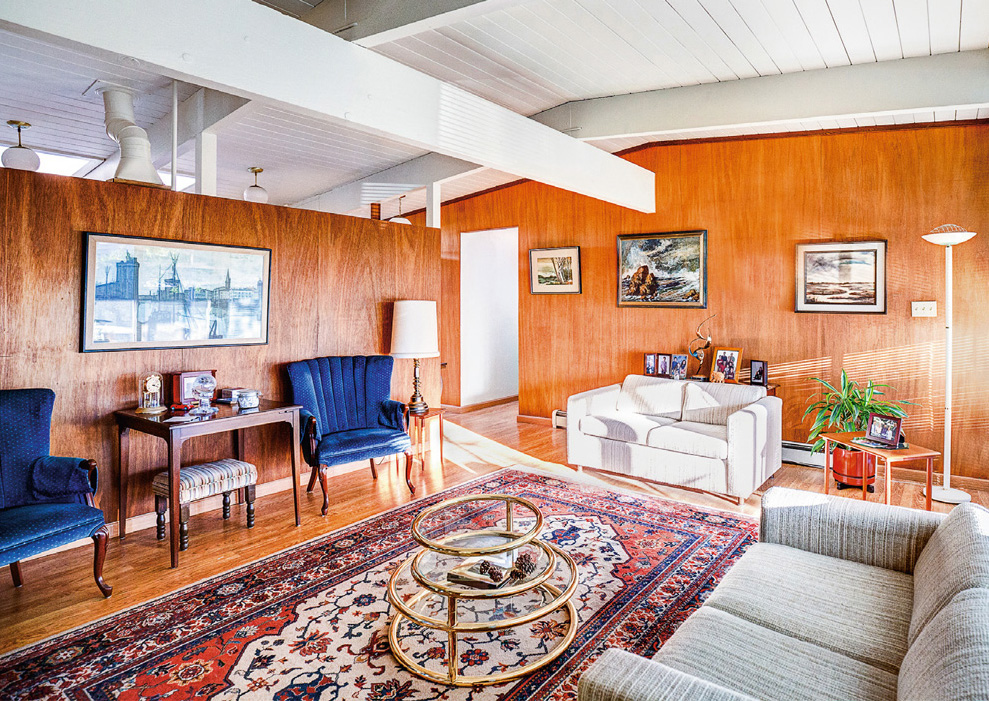
Contrary to the minimalist aesthetic is the eclectic approach that some owners adopt, incorporating traditional furnishings and antiques into their homes.
For certain, it never pays to turn an Eichler into a Cotswold cottage. Yet, done with discretion eclecticism can work, especially when, as was the case in the San Mateo Highlands home of Fred and Jean Leonard, wingback chairs and stools with turned supports play off the textures and colors of Eichler paneling.
Matt Kahn, an artist and interior designer who worked with Joe Eichler on many projects and lived in an Eichler on Stanford campus, argued that Eichlers are "permissive," open to owners doing with them what they will. His home was a good example, filled with art, seashells and river stones, colors, and surprises.
 |
|
|
Still, while we are considering the varying moods within Eichler homes, let's remember that Joe and all of his architects were moved deeply by the work of Frank Lloyd Wright, by the Arts and Crafts architects of California, and by Japanese designs. All these emphasized warm wood, textures, openness, even quietism.
Eichlers that play up their rustic roots achieve a quiet, sustained appeal. The atrium in Nancy Mar's Palo Alto Eichler, with its Japanese-influenced retractable cover and wooden flooring, is a peaceful oasis.
Some Eichler models emphasize textural interest. For example, a split-level model we visited that used vertical quarter-sawn redwood siding in its entryway and throughout other portions of the house. It's adds to an inviting, relaxing look—very homey.
 |
|
|
Hominess is a state that evolves naturally within a home, not something imported from a designer. For many years, the home that Joe Eichler had his original architects, Anshen and Allen, design for his own family in 1951, was owned by Paul Feder and Ginny Anderson.
The couple retained all the original architecture, save for some minor changes to the kitchen, and made the home their own by simply living there, spreading out, adding comforting places to sit and an array of objects that spoke to them. An Eichler with attitude can't get better than that.
- Login to post comments
Search