


Tribute to Robert Rummer
 |
|
|
West Coast builders Joe Eichler and Robert ('Bob') Rummer likely never met each other in their mid-century heydays, but the homes they built—Joe in California, Bob in the Portland area—had much in common.
So much in common, some say, that the two builders referred to the exact same architectural plans while erecting their homes. Others disagree.
The mystery and appreciation surrounding the Rummer saga just entered a new chapter with the passing of Rummer himself, at 97, on January 31. Family, friends, and Rummer homeowners and fans mourn the loss.
Eichler and two of his mid-century architects, A. Quincy Jones and Claude Oakland, were early players in the Rummer saga, but none of the three would be the main impetus to carry Rummer into building modern-styled homes.
 |
|
|
Give that credit to Bob's wife, Phyllis. In 1959, after she paid a visit to an Eichler home in California, Phyllis returned home to Newberg, Oregon, with the news that she would happily trade in the couple's new traditional home for a modern one with an open layout like the Eichler she had visited. Soon afterwards, Phyllis persuaded Bob to give up his career in insurance—and you know the rest.
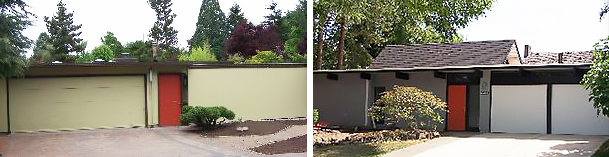
Reflecting on Rummer homes' similarity to Eichlers—stunning look-alikes with floor-to-ceiling glass and exposed beams, and floor plans that wrap around an interior atrium—has long been a fascination among mid-century modern fans, especially those in the Eichler world.
How much inspiration in Rummer's world was courtesy of Joe Eichler and his architects? Did any original Eichler architectural plans find their way to Oregon back then? Is there more to this story than 'pure coincidence'?
 |
|
|
Though Rummer claimed his company originated its own designs, in his 2002 research on Rummer homes, Oregon writer Joe Barthlow determined that many Rummer models he studied closely resembled specific Eichler designs—he found 16 model matches in all—and cited five designs in particular by Claude Oakland and three by Jones & Emmons.
Despite these documented drawings, the A. Quincy Jones Architecture Archive at UCLA still contended that Jones's affiliation with Rummer in the early 1960s was brief and unproductive, and "it would be wrong to say or to suggest that anything at all was 'designed' [for Rummer] by the firm. It is true there was interest, but there is really no evidence of work done…"
In addition, the Jones Archive confirmed a two-day meeting in Portland in 1961 between Rummer and Jones, who shortly afterwards invoiced Rummer for airfare, hotel, and per diem. Records indicate that a month later, Jones billed Rummer nearly $500 for "re-study and new drawings for a Portland house and Salem house."
 |
|
|
In a past interview, Bob Rummer confirmed that he had spent two weeks at a Bay Area Eichler subdivision under construction, where he observed Eichler crews building houses, and had several conversations with the construction foreman.
By the early 1960s, Rummer's home designs had drawn the attention of Eichler architect Claude Oakland and his attorney, according to Kinji Imada, an architect (and future firm partner) on Oakland's staff at the time.
"We were quite outraged to see the photo of his [Rummer's] house published in a magazine," recalled Imada. "Our attorney contacted Rummer, who denied that the plan had been copied, that it was just coincidence that there were similarities. That was totally absurd, of course…However, we were advised that there was nothing that we could do legally."
Search