


Breaking the Rules - Page 6
 |
|
|
To succeed in public relations, to really make a mark, requires a sharp mind, good language skills, and confidence. But more than any of these, it requires someone who believes in the product.
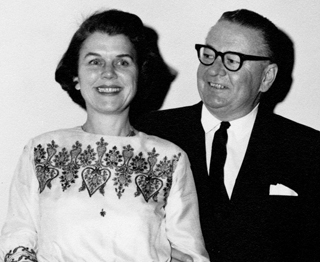
Elaine K. Sewell Jones, who was married to A. Quincy Jones for 17 years, was a believer.
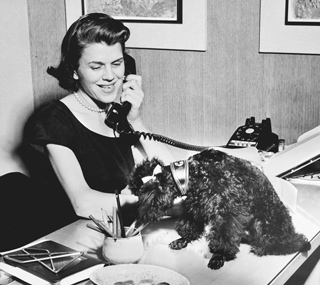
Elaine Jones (1918-2010) was a consummate public relations person—knowledgeable, creative, detail-oriented, and passionate about modern design and its creators.
"She was PR in the best sense of the word," remembers David Travers, the former editor of the magazine Arts & Architecture, who published several of her articles about modern architecture in the 1960s.
Among Jones' clients were Herman Miller, Inc. and its designers, including George Nelson; the firm Arcadia Metal Products, which manufactured sliding-glass doors; ceramicist LaGardo Tackett, and several architects. "She sincerely liked the stuff she was making a living from," recalls her friend Robert Hinerfeld.
In one case, at least, she actually loved the product she was pushing—architect A. Quincy Jones, whom she married in 1962.
"She thought he was the best architect in California, if not beyond," recalls John Gerard, an architect who worked on the Eichler account in the Jones & Emmons office in the late 1950s. Elaine Sewell was in the office often, writing about the firm, handling press matters, and more.
"It wasn't surprising when they got married," he says. Quincy Jones had recently divorced; it was a second marriage for Elaine as well.
Quincy Jones couldn't have found a better mate. He was a man who lived to work, Gerard recalls, sometimes putting in 80-hour weeks—even working Thanksgiving Day. So it helped to have a wife who worked in the office as well.
After they married, Elaine Jones worked as office manager, overseeing the workflow and keeping things organized. "Documents, drawings and sketches all were saved in their proper places," her friend, Susan Hinerfeld, remembers.
Elaine and Quincy worked well together, his daughter, Hillary Jones, says. "He was very passionate; she wasn't. She was very rational. They complemented each other."
It also helped that Elaine, a well-dressed, stylish woman, threw marvelous parties that attracted designers Charles and Ray Eames, architect John Lautner, Architectural Pottery's founders Max and Rita Lawrence, and the painter Wayne Thiebaud.
She often greeted guests at the door while cradling her tiny black poodle, Ditto, in her arms. "She really understood each guest and each guest's accomplishments," Susan Hinerfeld says, "so people would always shine in her presence."
The Barn, a former photo studio in a Santa Monica Boulevard building that resembled a New England barn, became the Jones home in 1965. Thanks to Elaine, it also became a social center, with parties that included an annual architectural-travel slide show by architect Emil Becsky. "Every architect in town had to be there," Gerard recalls.
 |
|
|
Throughout his career, Quincy Jones understood the importance of publicity. In 1953, when he designed a home for U.S. Gypsum Company's model Research Village project in Illinois, he accepted a $20 wager from U.S. Gypsum's publicity manager "that publicity resulting from our Research Village program would be a greater benefit to you than all other publicity you have received in your architectural career."
Jones lost the bet—which means of course that he won.
When Jones built his own house in the Brentwood Hills, he wrote Progressive Architecture about featuring it in an article. "I am not trying to kid anyone," he wrote. "I would like to get whatever publicity breaks I can on the house and, as well, naturally, any price breaks I can get on products [for the house]."
Several of the firms Elaine Jones represented, including Arcadia and Herman Miller, manufactured products that Jones often specified in his projects. He also designed a large campus for Herman Miller.
Elaine played a major role in fostering Quincy's reputation, planting stories in the architectural press, including a story about his designs for Eichler Homes, in Arts & Architecture.
- Login to post comments
Search