

First Impressions, Simple Statements - Page 5
Another option is to create a custom door made with a company that specializes in wood-framed carriage doors, which feature wood siding and are installed with low overhead tracks. This solution is heavier than traditional metal doors, so it’s important that you work with a contractor who can marry the load of the door with appropriate automatic door-opening hardware.
Simple, Stylish Entry Doors at Every Price Point
 |
|
|
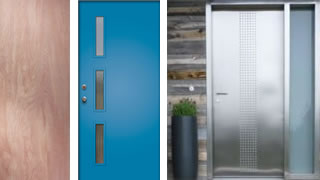
Nothing beats the formal simplicity of a flush front door. Here are three winning options, separated mostly by their price tags.
Budget: The Jeld-Wen composite unfinished flush slab door is engineered for durability with carefully selected raw materials. It has 1-3/4-inch frame thickness with a solid core and bare wood faces. The door can be stained or painted and offers reversible handing for flexible installation options. Hardware not included. Homedepot.com
Splurge: A contemporary take on the plain slab door is Neoporte’s Racerback model—a sheet of stainless steel accented with metal grommets that race up the center of the door. The company builds each door to order, and sidelites and transoms can be added for a total system. Nineteen door level styles and practical options including precision-machined peephole, solid stainless steel threshold, and a flush-mounted stainless steel doorbell. Starting at $11,750. Neoporte.com
Do-It-Yourselfer Powers Up His Own Garage Doors
 |
|
|
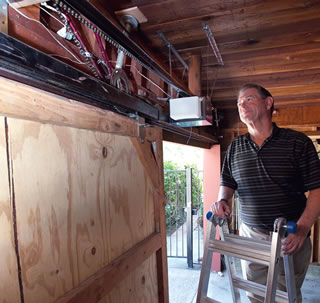
In today’s ‘I-have-a-remote-for-everything’ lifestyle, there’s really no good reason to have to settle for manual garage doors. Eichler’s original sliding garage doors weren’t automated, so Cupertino Eichler owner Ed Hirshfield decided to change all that a few years ago by creating his own automated system tied to his original doors.
“But I wanted electrically controlled garage doors consistent with the Eichler ethos,” Ed says.
Total disclosure: Hirshfield is an engineer by trade, and the plans he sent to CA-Modern certainly prove it. The good news is that he began the project with two Chamberlain (model HD175DM - ½ HP) garage door openers, which came with remote controls, and which he purchased on clearance for $10 each. “I didn’t want to reinvent the world,” Ed says. He rigged the rest of the project, MacGyver-style.
Ed started with the door closest to the house, mounting the Chamberlain hardware for the garage doors on a joist 11 inches away from the door opening. He installed the door trolley 13-½ inches from the ceiling.
The motor is hung from the ceiling with steel tape and attached to two-by-four-inch mounting boards. He used the door puller provided by Chamberlain but connected it to the door by attaching a five-and-three-eighths-inch bolt through the door hanger with a two-inch collar nut. The five-inch bolt flexes when the door motion is started or stopped to absorb shock.
The second door installation is more complicated because there is very little room for the motor and mechanism. Ed hung the second motor, rotated by 90 degrees, and centered 32 inches from the left edge of the open door. He then used the parts from two bicycle frames to support the chain, which was lengthened.
Both garage door opener motor assemblies come with travel limit switches that turn the motors on and off at the end of their movement. These switches are adjusted before the door is operated to assure that the doors do not move farther than they need to.
“Notwithstanding many of the fine adjustments in positioning of the parts during design, these doors have operated flawlessly for eight years,” Ed says. “Knock on wood!” Ed’s total out-of-pocket cost: $250 (at the time).
For those like Ed who love to tinker, this may be an ideal project for you. For the rest, automation is a phone call away.
Search